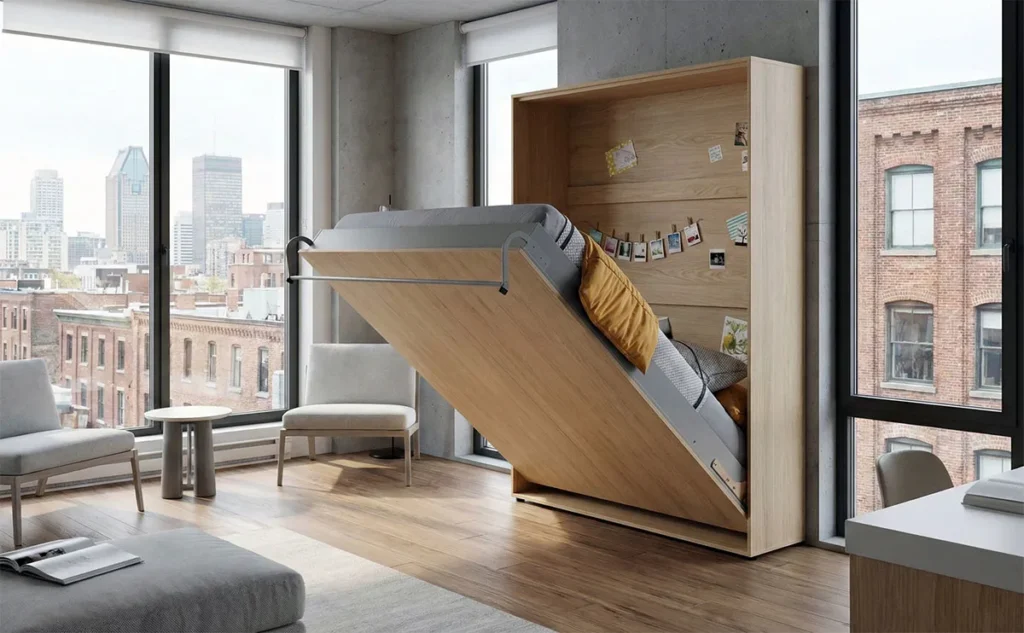

Condo Resale Value in Montreal with Wall Beds


Do wall beds actually pay off when you sell? We analyze the market data to see exactly how they impact Condo Resale Value in Montreal.
The Montreal real estate market has changed dramatically in the last five years. With the average condo price hovering around $425,000 to $480,000 and the cost per square foot rising in neighbourhoods like Griffintown, the Plateau, and Downtown, space has become the ultimate luxury.
For Montreal condo owners, the question isn’t just about decoration; it’s about Return on Investment (ROI). If you install a custom Murphy bed (wall bed), will you see that money back when you sell?
The short answer is: Yes, but only if done right.
In this guide, we break down how space-saving furniture impacts property value in Montreal’s unique housing market, backed by data and local trends.
Table of Contents
The “Space Premium” in Montreal Real Estate
To understand why a wall bed adds value, you first need to understand what you are selling. You aren’t just selling four walls; you are selling usability.
In 2025, the average size of a new condo in Montreal continues to shrink, while prices per square foot remain high. A 600 sq. ft. unit in Ville-Marie or a “shoebox” condo in Rosemont leaves very little room for wasted space.
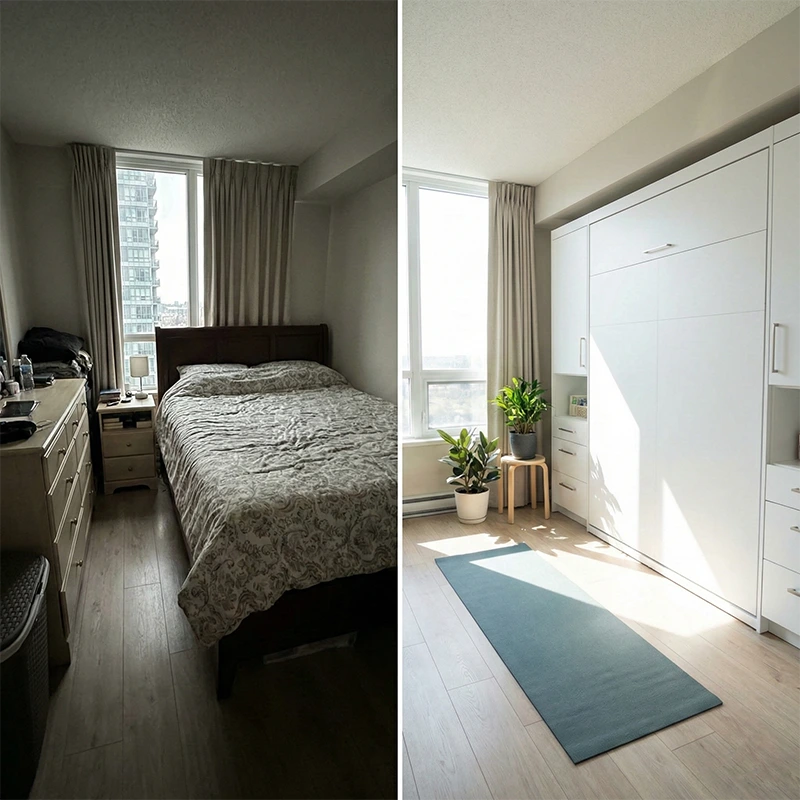
When a potential buyer walks into a 1-bedroom or a “1+1” (one bedroom plus a den), they are often doing mental math:
- “Where does my desk go?”
- “Can I have a guest sleep here?”
- “Is this room just for sleeping, or can I use it during the day?”
A permanent, traditional bed occupies roughly 30 to 40 square feet of “dead space” for 16 hours a day. In a Montreal condo where you might be paying $700+ per square foot, a traditional bed is effectively holding about $25,000 worth of real estate hostage.
The “Flex Room” Advantage
According to recent data from Canadian real estate boards, listings that highlight “flexible” or “multi-functional” spaces attract significantly more online views. A Murphy bed transforms a static bedroom into a Flex Room.
- Daytime: It’s a home office, a yoga studio, or a play area for kids (essential for young families in condos).
- Nighttime: It’s a full bedroom with a real mattress.
By installing a high-quality wall bed, you are effectively marketing your 1-bedroom condo as having the functionality of a 2-bedroom unit, or your studio as a 1-bedroom. This perceived increase in usable square footage is where the resale value lies.
Modern vs. “Old School”: Quality Matters
A major misconception among Montrealers is that wall beds are those creaky, spring-loaded traps from old movies.
If you install a cheap, particle-board unit, it will not increase your resale value. In fact, it might hurt it, as buyers will see it as something they need to tear out.
To add value to your condo, the bed must be viewed as a fixture, not just furniture.
What Buyers Are Looking For:
- Custom/Built-in Look: The bed should look like a high-end closet or wardrobe when closed. It needs to blend seamlessly with the wall.
- Quality Mechanism: Modern hydraulic or spring-balanced mechanisms (like the ones found in high-end DIY kits) are safe, light to operate, and silent.
- Storage Integration: The highest ROI comes from units that include side cabinets, shelving, or even a fold-down desk. This solves the #1 complaint of condo living: lack of storage.
Pro Tip for Montreal Sellers: If you are handy, utilizing a DIY hardware kit allows you to build a custom unit that fits your specific alcove or wall dimensions perfectly. A custom-fitted look signals to buyers that the unit is a permanent, thoughtful upgrade to the home, similar to a renovated kitchen or a custom closet organizer.
The Financial Breakdown: ROI on Wall Beds
Let’s talk numbers. Does spending $1,500 on a wall bed translate to a higher sale price?
When evaluating renovations for resale, real estate agents often look at the Cost vs. Value report. While kitchen and bathroom remodels often recoup about 75-100% of their cost, “smart storage solutions” are increasingly becoming a high-yield category, especially in urban centres like Montreal.
The “DIY” Arbitrage
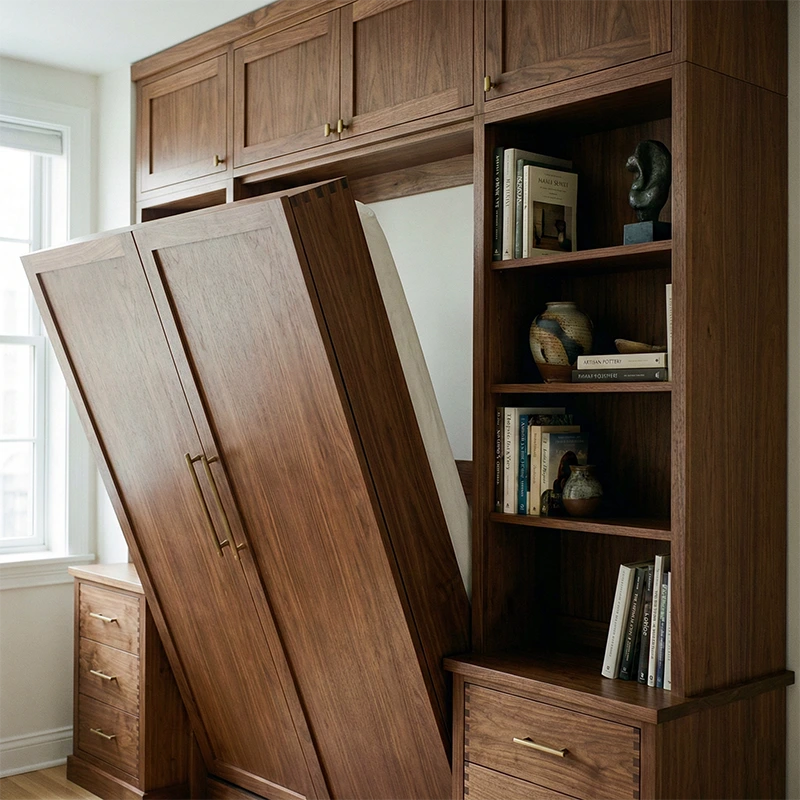
This is where the math gets interesting for handy homeowners.
- Pre-Fabricated Units: Buying a high-end, pre-assembled wall bed from a luxury furniture store in Montreal can cost upwards of $3,000 to $5,000. While it adds value, your net profit on resale might be slim.
- The Custom DIY Route: By purchasing a professional-grade hardware kit (often under $500) and sourcing your own wood (plywood or MDF) from a local supplier, you can build a unit for roughly $1,000 – $1,200 total.
- The Payoff: Because the final product looks like a $5,000 custom built-in, you capture that equity gap. You spent $1,200, but the buyer perceives a $5,000 value upgrade.
“Speed of Sale” is Money
Even if a wall bed doesn’t technically raise your appraisal value by $10,000, it drastically reduces Days on Market (DOM). In a competitive market like Griffintown or Le Plateau-Mont-Royal, listings that solve a problem (lack of space) get bookmarked faster.
A condo that sits on the market for an extra month costs you carrying costs (mortgage, condo fees, taxes) which can easily exceed the cost of installing the bed.
Who is Buying Your Condo?
To maximize resale value, your renovation must appeal to the specific buyer pool for your neighbourhood. In Montreal, wall beds are a “must-have” feature for three specific groups:
The “Work-From-Home” Professional
Post-pandemic, the demand for home offices in Montreal remains high. A buyer looking at a 1-bedroom condo in Old Montreal is likely a young professional.
- The Problem: They need a dedicated office but can’t afford a 2-bedroom unit.
- The Solution: A second bedroom with a Murphy bed is an office by day and a guest room by night. A studio with a Murphy bed is a living room by day and a bedroom by night.
The Student Investor (McGill / Concordia / UdeM)
Parents buying condos for their children attending university are looking for efficiency.
- The Appeal: A studio apartment near the McGill Ghetto or Guy-Concordia is a prime investment. A wall bed allows the student to have a desk and a “living room” setup for hosting friends, which is impossible with a queen-sized bed taking up 60% of the floor space.
The “Pied-à-Terre” Snowbird
Many retirees keep a small condo in the city (perhaps in Laval or Nuns’ Island) while spending winters in Florida. They want a space that is low-maintenance and spacious enough for grandkids to visit. A wall bed offers that flexibility without the footprint of unused guest beds.
Wall Beds vs. Alternative Solutions
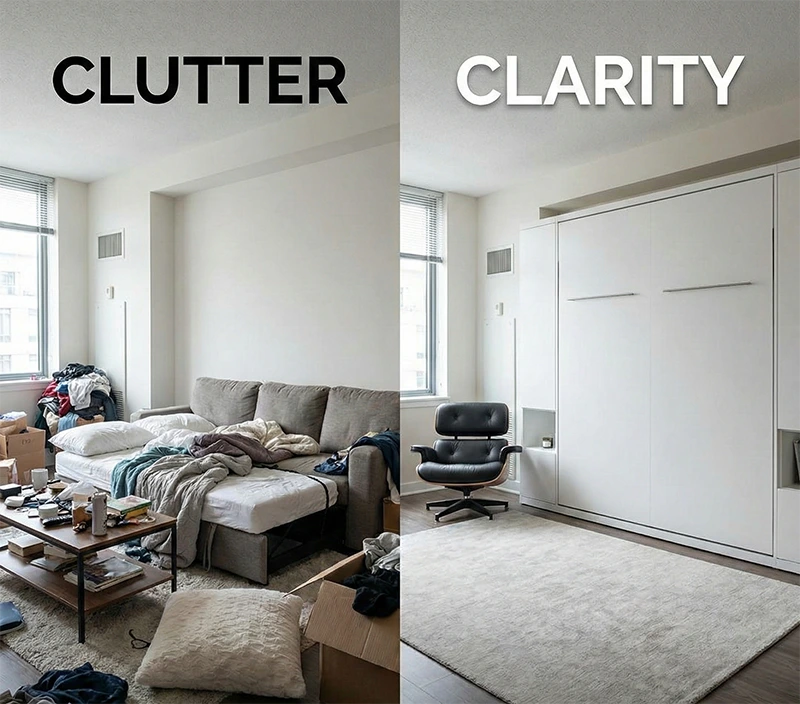
We must acknowledge that wall beds aren’t the only solution. However, when compared to the alternatives, they are often the only one that adds resale value.
1. Sofa Beds (The “Pull-Out” Couch)
- Pros: Cheap, no installation required.
- Cons: Notoriously uncomfortable. Requires moving coffee tables every night. “Temporary” solution.
- Verdict: Does NOT add resale value. Buyers see a sofa bed as your furniture, not a feature of the condo.
2. Loft Beds
- Pros: Maximizes vertical space.
- Cons: Dangerous for seniors/children. Feels “dorm-room” cheap. Hard to change sheets.
- Verdict: Can DECREASE resale value. Many buyers will see a loft bed as a structure they have to demolish.
3. Cabinet Beds (Free-standing)
- Pros: Portable, no wall attachment needed.
- Cons: Takes up floor space even when closed. Looks like a bulky chest.
- Verdict: Neutral value. It’s furniture, so you take it with you when you move. It doesn’t help the “listing price.”
4. Custom Murphy Bed (Wall-Mounted)
- Pros: Uses vertical wall space. Real mattress comfort. Can be integrated with moulding/trim.
- Cons: Requires installation (stud finding, leveling).
- Verdict: INCREASES resale value. Because it is attached to the wall, it is often considered a “fixture” (inclusions) in the real estate contract, justifying a higher asking price.
Montreal Real Estate FAQ
Q: Does a Murphy bed legally turn a den into a bedroom?
A: In Quebec real estate law, a “bedroom” technically requires a window and a closet. Installing a Murphy bed in a windowless den (a “1+1” layout common in Griffintown or Downtown Montreal) does not legally change the classification to a 2-bedroom on the certificate of location.
- However: It does change the marketable utility. Real estate agents will list it as “1+1 (used as 2nd bedroom)” and buyers will pay a premium for that functional utility, even if the tax assessment doesn’t change.
Q: Do I need condo board approval to install a wall bed?
A: Generally, no. A wall bed is attached to the studs of your unit’s internal walls. It does not affect the common elements or the structural integrity of the building.
- Caveat: If you are renting or in a strictly regulated co-op (undivided co-ownership), check your declaration of co-ownership. For standard divided condos (condominiums divis), you are free to screw into your own drywall studs.
Q: Is a wall bed considered a “Fixture” or “Chattel”?
A: This is crucial for the sale. In Quebec, anything “permanently attached” to the wall is considered an immovable by destination (fixture) and is usually included in the sale unless specifically excluded in the Promise to Purchase.
- Seller Strategy: List the custom wall bed as an inclusion. This justifies a higher asking price. If you plan to take the mechanism with you, you must repair the wall holes, which can be a hassle and turn off buyers. It is usually more profitable to sell the unit with the bed and buy a new kit for your new home.
The “Griffintown Effect”: Why Location Matters
Not all Montreal neighborhoods value space equally. The ROI of a Murphy bed spikes in areas where price-per-square-foot is highest.
| Neighbourhood | Avg. Condo Size | Buyer Profile | Murphy Bed ROI Potential |
| Ville-Marie (Downtown) | 500-700 sq.ft. | Students, Young Pros | High (Essential for livability) |
| Griffintown | 600-800 sq.ft. | Couples, Investors | Very High (Converts den to office/guest room) |
| Plateau-Mont-Royal | 800-1000 sq.ft. | Creative Class, Small Families | Medium (Good for weird, old layouts) |
| Laval / South Shore | 1000+ sq.ft. | Families, Retirees | Low (Space is less of a premium) |
Local SEO Tip: If you are selling in Griffintown, mentioning “custom wall bed office” in your Centris listing description is a powerful keyword trigger that differentiates your unit from the 50 other identical units in your building.
The Verdict on Value

So, is a Murphy bed worth the investment for resale in Montreal?
If you treat it as a cheap piece of furniture, no. A clunky, metal-spring bed that looks like it belongs in a motel will not impress a buyer paying half a million dollars for a condo.
However, if you treat it as a architectural feature—a built-in solution that unlocks the hidden potential of a small room—the ROI is undeniable.
The “DIY” Sweet Spot
For the savvy homeowner, the path to profit is clear:
- Don’t overspend on pre-made luxury brand furniture ($5,000+).
- Invest in a high-quality hardware kit ($300-$500) that offers safety and smooth operation (piston or spring mechanisms).
- Build it yourself (or hire a local handyman) to fit your specific nook or wall.
By doing this, you spend roughly $1,000 to add a feature that buyers perceive as a $5,000 upgrade. In the competitive Montreal market, that “wow factor” is often the difference between a listing that lingers and one that sells over asking.
Ready to upgrade your space?
Don’t let square footage limit your lifestyle—or your resale value. Start planning your custom project today.