

Wall Bed Weight Limits: Safe Sleep in Montreal


Is a wall bed actually safe for daily use? It is the most common question we hear. Before you start your DIY assembly, you need to trust the engineering behind the aesthetics.
Here is the no-nonsense guide to Murphy Bed Weight Limits, static loads, and why our Montreal-made steel frames are built to handle heavy-duty sleep with ease.
Living in Montreal, we understand the value of a square foot better than almost anyone. From the charming but compact studios of the Mile End to the sleek, space-conscious condos rising in Griffintown, our city demands intelligent design.
The Murphy bed—or wall bed—is the ultimate solution for reclaiming that space. However, before you jump onto our online design tool to customize your dream unit, there is a fundamental question that every safety-conscious homeowner asks: “How much weight can a Murphy bed actually hold?”
It is a valid concern. You are essentially sleeping on a piece of mechanical engineering that folds away into a cabinet.
In this comprehensive guide, we will strip away the marketing fluff and dive deep into the technical specifications, structural realities, and safety ratings of modern Murphy beds.
Table of Contents
Defining the Wall Bed Weight Limits
Whether you are building a guest suite in a Westmount basement or a primary bedroom in a downtown loft, understanding weight limits is the key to sleeping soundly.
It Is Two Different Numbers:
When customers ask about “weight limits,” they are usually thinking about one thing: how heavy a person can be to sleep on the bed. However, in the world of wall bed engineering, we deal with two distinct types of weight ratings. Confusing these two can lead to improper installation or difficult daily use.
1. Static Load Capacity (The “Sleeping” Weight)

This is the number most people care about. Static load refers to the total weight the bed can support when it is fully open, with the leg support resting firmly on the floor.
- The Reality: Once a high-quality Murphy bed is open, it functions almost exactly like a standard platform bed. The weight is transferred directly down through the steel frame and the legs into the floor.
- The Industry Standard: For the high-grade, Canadian-made steel frames we use in our Montreal workshop, the static load capacity is incredibly high.
- Double / Full Beds: Typically rated for 1,000 lbs (453 kg).
- Queen Beds: Typically rated for 1,000 lbs (453 kg).
- King Beds: Can often support even more, depending on the leg structure.
- What this means for you: Unless you plan on parking a small car on your mattress, a properly assembled Murphy bed is more than capable of supporting two adults, a heavy mattress, thick winter duvets, and the family dog, with zero risk of structural failure.
2. Dynamic Load Capacity (The “Lifting” Weight)
This is the number that dictates the functionality of your bed. Dynamic load refers to the amount of weight the lifting mechanism (the pistons or springs) can handle while the bed is being raised or lowered.
- The Balance: The mechanism is designed to counterbalance a specific range of weight. This weight includes the metal frame, the wooden face panel (which you can customize on our site), the mattress, and the bedding.
- The Danger Zone: This is why we always tell our customers: Never try to ride the bed up into the wall. The pistons are calibrated to lift roughly 100-150 lbs of mattress weight, not the weight of a person.
- The “Sweet Spot”: If your mattress is too light, the bed might try to float up on its own. If your mattress is too heavy (exceeding the dynamic limit), you will have to struggle to lift it, potentially straining your back or wearing out the pistons prematurely.
The Mattress Factor
Weight Considerations for Montreal Sleepers
Since our business model allows you to design your cabinet online and assemble it yourself, you have the freedom to choose your own mattress. You are not stuck with a thin, uncomfortable “wall bed mattress.” However, because you are sourcing your own mattress, you need to be a savvy shopper regarding weight.
Memory Foam and Hybrids (The Heavyweights)
Memory foam is dense. A high-quality 12-inch Endy or Douglas mattress (popular Canadian brands) can be significantly heavier than an old-school spring mattress.
- Density: Higher density foam lasts longer but adds pounds. A Queen memory foam mattress can weigh anywhere from 60 lbs to over 100 lbs.
- The Fix: When using our design tool, ensure you check the specifications for the mechanism. Most of our standard Queen kits are rated to handle mattresses between 60-80 lbs comfortably. If you choose a “heavy-duty” luxury mattress, you may need a mechanism with a higher Newtons rating (force) to assist the lift.
Latex Mattresses (The Super-Heavyweights) Natural latex is incredibly comfortable and eco-friendly, a popular choice in eco-conscious Montreal neighbourhoods. However, it is also essentially solid rubber. A Queen latex mattress can weigh 120 lbs or more.
- Warning: If you plan to use 100% natural latex, please consult with us before ordering. Standard gas pistons may struggle to keep the bed down or make it difficult to lift.
Traditional Coil / Innerspring (The Lightweights) These are generally the safest bet for weight limits. They are lighter, breathable (good for humid Montreal summers), and rarely exceed the dynamic weight limits of standard mechanisms.
Structural Integrity: Steel vs. Wood Slats
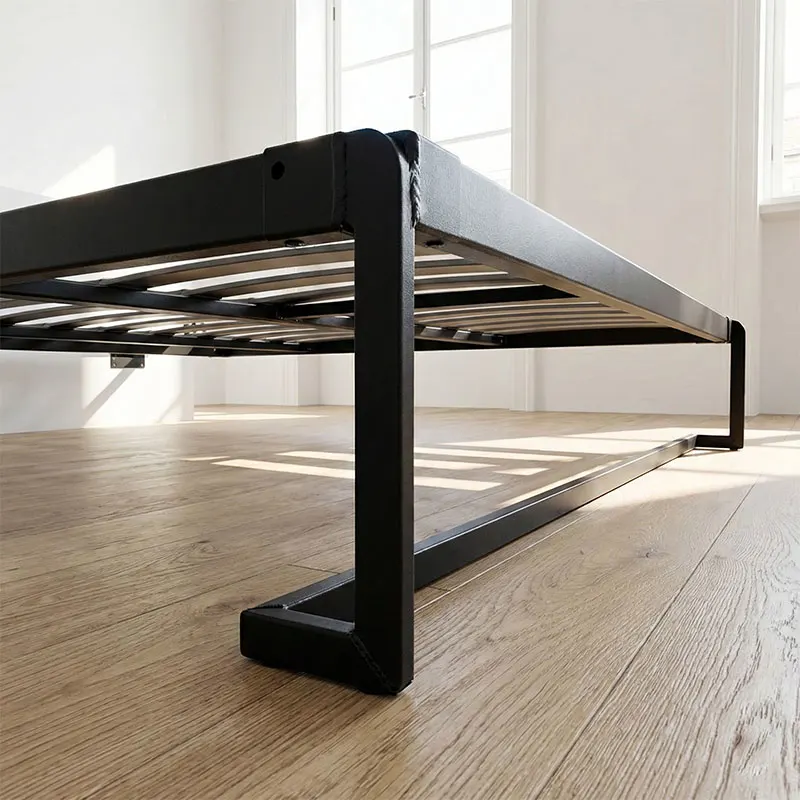
The massive 1,000 lb static weight limit mentioned earlier is only possible because of the materials we use. Many cheaper, “bed-in-a-box” Murphy beds shipped from overseas use wooden slats that bow over time. In our local workshop, we prioritize longevity. The core of our system is a tubular steel frame.
- No Sagging: Unlike wood, steel does not warp with humidity changes—a crucial factor in Quebec where we swing from -30°C dry winters to +30°C humid summers.
- Even Distribution: The steel frame ensures that the weight of the sleepers is distributed evenly to the mechanism and the floor legs. This prevents “point loading” where a heavy knee or elbow could snap a wooden slat.
The Impact of Bedding
It might seem trivial, but in Canada, bedding has weight! A thick, down-filled winter duvet, flannel sheets, and a weighted blanket can easily add 15-20 lbs to the bed.
- Pro Tip: When balancing your bed (which you will do during the DIY assembly process), always make sure the bedding is ON the bed. If you calibrate the springs or pistons with a naked mattress, the bed will feel too heavy once you dress it for winter.
Why “Local” Means Safer
You might wonder why a local Montreal business emphasizes weight limits more than the big online giants like Wayfair or Amazon. The answer is accountability and climate. Mass-produced furniture often lists “theoretical” weight limits based on computer models.
Because we operate a local workshop where we cut the cabinets and you assemble the final product, we deal with real-world physics. We know that a bed in a humid Plateau apartment behaves differently than one in a dry Arizona home.
By designing your bed with us, you are getting a system rated for real use, ensuring that whether you are hosting visiting parents or using the bed every night in your studio, the weight limits are honest, tested, and reliable.
The Mechanism and Material Science
Now that we have established the difference between static and dynamic loads, we need to look at the machinery that makes a Murphy bed work.
This is the heart of the system. When you use our online design tool to configure your room, you aren’t just picking pretty colours; you are building a machine. Understanding the materials and mechanisms will help you design a unit that manages weight effortlessly for decades.
The Great Debate: Pistons vs. Springs
There are two main ways to lift a Murphy bed. Both have their pros and cons regarding weight management.
1. Gas Pistons (The Modern Standard)
These resemble the struts that hold up the hatchback trunk of your car, but much larger and more powerful.
- How they handle weight: Pistons are non-adjustable. They come pre-charged with a specific amount of force (measured in Newtons). For example, a standard Queen bed might require two 800N pistons.
- The Pros: They offer a sleek, quiet, and smooth operation. They often have a “soft-open” feature where the bed glides down gently rather than dropping.
- The Cons for Weight: Because they are non-adjustable, you have less margin for error with your mattress choice. If you swap a light coil mattress for a heavy memory foam one later, you might need to buy new pistons.
- The Canadian Winter Factor: Gas pistons can be sensitive to extreme cold. If your Murphy bed is installed in a solarium or a poorly insulated room in Montreal, the gas can contract slightly in -20°C weather, making the bed feel a tiny bit heavier to lift until the room warms up.
2. Spring Mechanisms (The Heavy-Duty Classic)
These use a bank of heavy-duty steel springs to counterbalance the weight.
- How they handle weight: Springs are adjustable. When you assemble the bed yourself, you hook up a specific number of springs based on your mattress weight. If the bed is too heavy, you add a spring. If it won’t stay down, you remove one.
- The Pros: Ultimate flexibility. If you upgrade your mattress in five years, you can simply adjust the spring tension rather than buying new parts. They are virtually indestructible and unaffected by temperature.
- The Cons: They can be slightly noisier (a metallic “twang”) if not properly lubricated, though modern kits are much better than the old iron beds of the 1980s.
Material Density: Why Melamine Matters
A Murphy bed cabinet is subjected to significant torque and stress. Every time you pull the bed down, the mechanism pulls against the side panels of the cabinet. If the wood is too light or weak, the screws can rip out.
- Commercial Grade Melamine: In our Montreal workshop, we use industrial-grade melamine boards. This is not the hollow, honeycomb cardboard stuff you find at IKEA. This is dense, heavy composite wood designed for structural cabinetry.
- Weight = Stability: A heavy cabinet is actually a good thing. The weight of the cabinet helps anchor the unit to the floor and creates a solid center of gravity. When you design a unit with side cabinets (wardrobes or shelving) using our online tool, you are adding mass to the structure, which increases its overall stability and safety.
- Edge Banding: We use high-quality PVC edge banding. This seals the wood core, preventing moisture from entering. In humid Montreal summers, this prevents the wood from swelling, which would otherwise weaken the screw holding power and reduce the weight capacity.
The DIY Assembly Role in Weight Safety
You might think, “Wouldn’t it be safer if a professional installed it?” Not necessarily. When you assemble the bed yourself, using the detailed instructions we provide, you gain an intimate understanding of how the weight is supported.
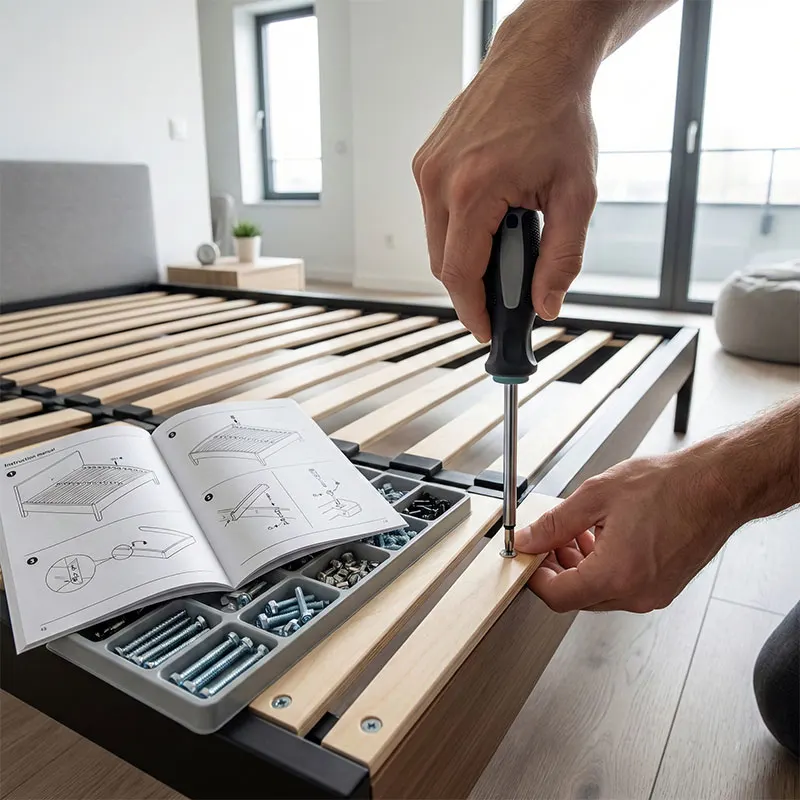
- Torque: You control how tight the bolts are.
- Verification: You see the steel brackets going into the wood.
- Ownership: You aren’t rushing to get to the next job. You are building your bed. This care and attention to detail during the DIY process often leads to a sturdier, safer final build than a rushed contractor job.
The Customization Factor: Designing for Weight
Our unique selling point is that you can design your room online. However, every design choice has a weight implication.
- Handles and Hardware: When you choose heavy, solid steel bar handles for the face of the bed, you are adding weight to the “Dynamic Load.” While a few pounds of handles won’t break the bank, it adds up.
- Face Panels: A standard flat panel is light. If you choose a “Shaker” style or add molding to the front of the bed to match your Victorian home’s decor, you are adding significant weight to the front panel.
- Design Tip: If you plan on adding heavy custom woodwork to the face of the bed after you pick up the kit, let us know! We may need to supply you with stronger pistons to compensate for that extra beautiful (but heavy) wood.
- Depth of Cabinet: We offer different depths. A deeper cabinet allows for a thicker mattress. If you want that 14-inch pillow-top mattress, you need the deeper cabinet. This increases the leverage arm slightly, but our mechanisms are engineered to handle it.
The “Workshop” Advantage
Why does our business model—renting a workshop on weekends to fulfill online orders—result in a safer product? It comes down to Quality Control (QC).
- Batch Manufacturing: Because we aren’t running a 24/7 factory churning out thousands of units, we inspect every sheet of melamine and every steel frame personally.
- Precision Cutting: We use CNC machinery during our weekend production runs. This ensures that the pilot holes for the mechanism are drilled to within a fraction of a millimetre.
- Why this matters for Weight: If a mechanism is mounted even 2mm off-center, the weight distribution becomes uneven. This causes one piston to work harder than the other, leading to early failure. Our precision manufacturing ensures the load is perfectly balanced, maximizing the lifespan and weight capacity of the bed.
Installation
We have covered the strength of the steel frame and the power of the lifting mechanism. But there is one final link in the chain of safety: the wall. A Murphy bed is only as safe as its connection to your home.
Because our business empowers you to assemble and install the bed yourself, we want to arm you with the specific knowledge needed for Montreal’s unique housing stock. Whether you are in a 1920s duplex or a 2024 new build, properly anchoring your bed is what guarantees it can handle the weight without tipping.
The Golden Rule: Anchor to Studs, Not Drywall
It cannot be stressed enough: You cannot rely on drywall anchors alone. The “tipping force” of a Murphy bed when it is being opened is significant. A plastic plug in drywall will pull right out, causing the cabinet to fall forward. To safely manage the weight, you must lag bolt the top of the cabinet into the structural studs of your wall.
Scenario A: The Plateau & Mile End (Lathe and Plaster)
Many of our customers live in beautiful, character-filled apartments with original plaster walls.
- The Challenge: Stud finders often struggle with plaster because the wooden “lathe” strips behind the plaster confuse the sensor.
- The Weight Risk: Plaster is brittle. It cannot support weight on its own.
- The Solution: You need to find the solid wood studs deep behind the plaster. We recommend using a strong magnet (to find the nails holding the lathe to the studs) or drilling small test holes behind where the cabinet will sit. You will likely need longer screws (3 to 4 inches) to pass through the thick plaster and bite deep into the wood stud.

Scenario B: Downtown & Griffintown (Metal Studs)
Modern condos in Montreal often use metal studs instead of wood.
- The Challenge: A regular wood screw won’t hold in thin sheet metal. It will strip out under the weight of the bed.
- The Solution: You need specific “toggle bolts” or “snaptoggles.” These anchors flip open inside the hollow metal stud, distributing the weight across a larger area of the metal. When designed correctly, a metal stud installation is incredibly strong.
Scenario C: Old Montreal & Lofts (Brick and Concrete)
Exposed brick is a Montreal staple.
- The Challenge: You cannot drill into mortar (it crumbles). You must drill into the brick itself or the concrete wall.
- The Solution: You will need a hammer drill (which you can rent easily) and “Tapcon” concrete screws or sleeve anchors. These provide immense holding power, easily capable of securing the 1,000 lb potential load of the bed.
Troubleshooting Weight Issues After Assembly
Since you are assembling the bed yourself, you are also the chief mechanic. Here is how to troubleshoot weight issues once the bed is built:
Problem: The bed feels incredibly heavy to lift.
- Cause 1: The mattress is heavier than the mechanism rating.
- Cause 2: You are trying to lift it without the mattress on it (wait, that would make it light to lift, but hard to close!).
- Most Likely: The mechanism tension is too low. If you have a spring system, you need to add more springs. If you have pistons, you may need to upgrade to a higher Newton rating.
Problem: The bed won’t stay down (it floats up).
- Cause: Your mattress is too light (perhaps a thin foam mattress).
- The Fix: Add weight! Heavier bedding helps. Alternatively, you can remove a spring (on spring systems).
- Note: New gas pistons can be stiff; leave the bed open with some weights on it for 24 hours to help break in the seals.
Problem: The cabinet moves slightly when I pull the bed down.
- Cause: DANGER. This means your wall anchors are loose.
- The Fix: Stop using the bed immediately. Re-tighten the wall anchors or find a new stud. The cabinet must be rock solid against the wall.
FAQ: Your Questions Answered
Q: Does the bed need to be drilled into the floor?
A: No. This is a huge benefit for renters in Montreal who want to protect their hardwood floors. The physics of the bed relies on the wall anchors to prevent tipping. The floor just supports the downward weight. No holes in the floor are required.
Q: Can I disassemble the bed if I move apartments?
A: Yes! Because our kits use high-quality cam-locks and machine screws (not just wood screws), you can disassemble and reassemble the unit multiple times. The weight capacity will not degrade as long as you don’t strip the fittings.
Q: I’m a large person (250lbs+). Is this safe for me?
A: Absolutely. The 1,000 lb static limit is designed exactly for this. The steel frame is key. Unlike wooden slats that might crack, steel offers rigid support. Just ensure your mattress is of good quality to prevent “bottoming out.”
Maintenance for Longevity
To keep the weight capacity secure for years:
- Check the bolts: Every 6 months, do a quick check of the bolts connecting the bed face to the mechanism arm. The movement can vibrate them loose over time.
- Lubricate: A quick spray of silicone lubricant on the pivot points keeps the lift smooth.
- Inspect the Legs: Ensure the flip-down legs are fully extended every time you open the bed. They take 100% of the weight; if they are crooked, the frame could bend.
Reclaim Your Space with Confidence
A Murphy bed is more than just furniture; it’s a lifestyle choice. It allows you to turn a home office into a guest room, or a studio into a living room. By choosing a locally made, steel-framed kit, you are choosing safety and durability.
The weight limits of our beds are designed to handle real life—kids jumping, heavy duvets, and restful nights. By utilizing our Online Design Tool, you get the custom look you want. by utilizing our Workshop model, you get the local quality you deserve. And by handling the Assembly yourself, you get the peace of mind knowing it was built right.
Ready to start your project? Don’t let the fear of “heavy lifting” stop you. Visit our website today to start designing your custom wall bed. Select your dimensions, choose your finish, and let us prepare your kit for pickup right here in Montreal.
[Launch the 3D Design Tool Now]