
Wall Bed or Sofa Bed: Sleep on a Real Mattress


Facing the Wall Bed or Sofa Bed dilemma is a fact of life for anyone in a compact Montreal studio or Vancouver condo. You know the struggle: do you sacrifice your living room for a real bed, or give up sleep comfort just to have a place to sit?
When every square foot counts, you are likely torn between the two heavyweights of space-saving furniture: the Wall Bed (Murphy Bed) and the Sofa Bed.
While the sofa bed is the traditional “go-to” for guests, if you are looking for a daily sleeper, there is a clear winner. Here is the honest truth about Wall Beds vs. Sofa Beds for small spaces, and why prioritizing a real mattress is the best decision you can make for your health.
The fundamental difference between these two space-saving giants isn’t just about how they fold away; it is about the structural integrity of what you sleep on. When comparing The Wall Bed or Sofa Bed, you are essentially comparing a permanent bed to a temporary cot.
Here is why your choice of mechanism dictates your quality of sleep.
Table of Contents
Sleep Quality: Don’t Ruin Your Back
Which offers better sleep quality؛ a Wall Bed or Sofa Bed?
A sofa bed (pull-out) is an engineering contradiction: it tries to be a soft seat and a flat bed simultaneously, often failing at both. Because the mattress must vanish inside the sofa frame, it faces severe physical limitations:
- The “Origami” Factor: The mattress must be folded twice or three times. To achieve this, it can be no thicker than 4 to 5 inches.
- The Support System: Most sofa beds rest on a canvas deck suspended by springs (trampoline style) or, worse, a rigid metal bar structure.
- The Inevitable Sag: Without a solid base, the heavy parts of your body (hips and shoulders) sink.
The Result: You likely know the feeling of the “bar in the back”—that rigid metal crossbar digging into your lumbar spine at 3 AM. Furthermore, because the mattress is constantly being bent and crushed, the foam breaks down rapidly, leading to the “taco effect” where two sleepers inevitably roll into the sagging centre.
The Wall Bed Advantage
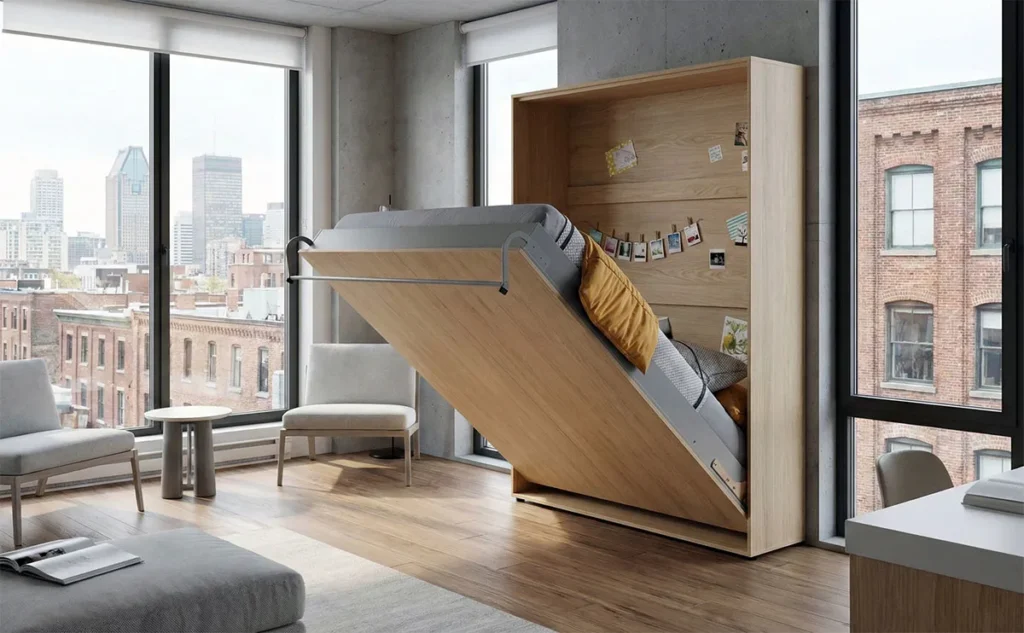
A Wall Bed (Murphy Bed) flips the script. It does not ask the mattress to fold; it simply asks it to stand up. Because the mattress remains flat 100% of the time, the limitations disappear.
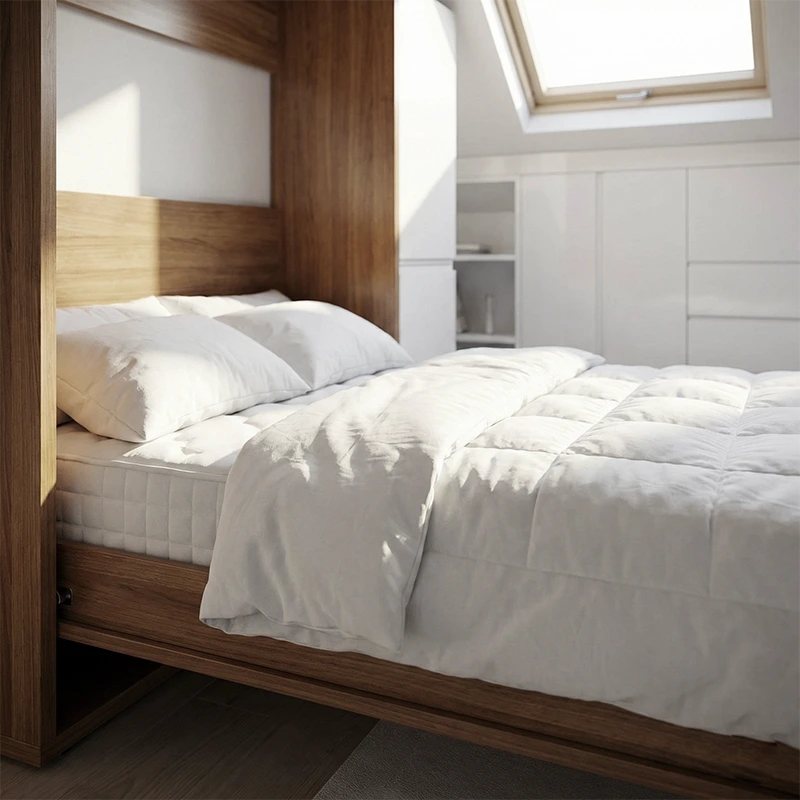
- Bring Your Own Mattress: With our custom DIY wall bed kits, you are not stuck with a factory-issued pad. You can use almost any standard coil, memory foam, or hybrid mattress (typically up to 10-12 inches thick).
- Solid Foundation: The mattress rests on a proper slat system or solid panel, providing the same orthopedic support as a high-end platform bed.
- Longevity: Since the mattress is never folded or crushed inside a box, it lasts just as long as it would on a regular bed frame.
The “Sheet” Factor: There is another hidden advantage to the wall bed. Because the mattress stays flat, you can keep your sheets and duvet on the bed when you close it. With a sofa bed, you must strip the bed, fold the sheets, and find a closet to store the duvet every single morning. A wall bed is ready to sleep in seconds.
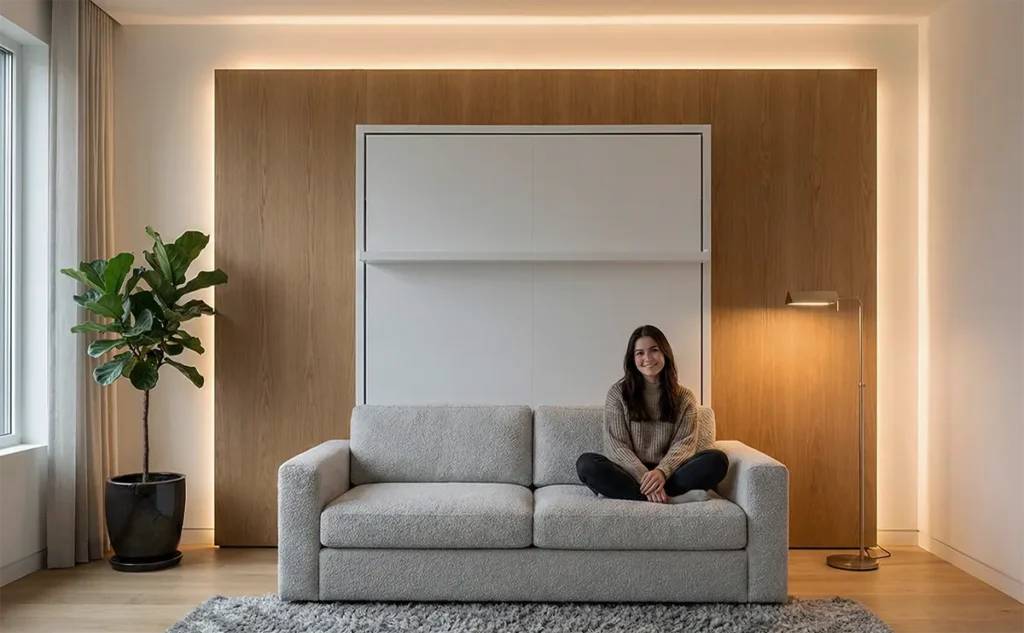
Wall Bed with Sofa: The Best of Both Worlds
According to recent search trends, the wall bed with sofa is becoming the gold standard for micro-living.
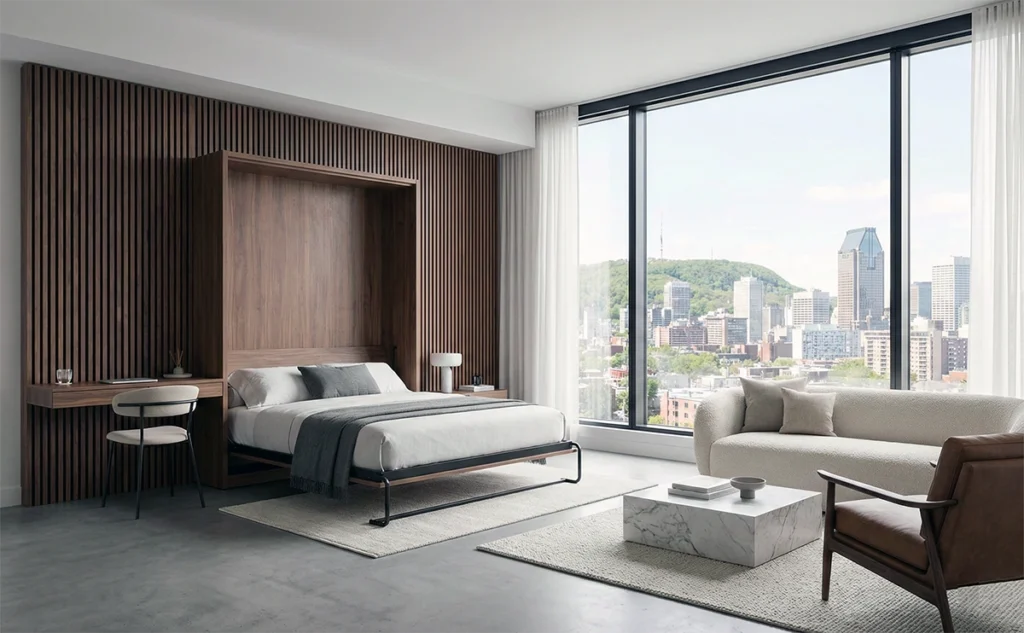
This configuration solves the “living room” problem. When the bed is up, you have a comfortable, stylish sofa. When the bed comes down, it hovers over the sofa (or the cushions are removed), revealing a full-sized bed with a real mattress.
Pro Tip: For specifically tight rooms, a horizontal wall bed with sofa might be a better fit than a vertical one, as it projects less into the room when open.
Comparison: Wall Bed vs. Sofa Bed
To help you decide, let’s look at the specs side-by-side.
| Feature | Sofa Bed (Pull-out) | Wall Bed (Murphy Bed) |
| Sleep Comfort | Low to Medium (Thin mattress, bars) | High (Standard real mattress) |
| Daily Use | Not recommended for daily sleeping | Excellent for every night use |
| Floor Space | Takes up space permanently | Clears floor space completely when up |
| Setup Time | Wrestling with cushions and heavy frames | Pulls down in seconds (counter-balanced) |
| Customization | Limited to fabric choices | High (shelving, size, mechanism) |
| Assembly | Usually comes pre-assembled (heavy) | DIY Assembly (easier to move into tight spaces) |
Why Does DIY Wall Bed Win the Day?
A Custom DIY Wall Bed is the Ultimate Space Hack
A common misconception is that installing a Murphy bed is a major renovation project requiring contractors, noise, and a massive budget. That might have been true a decade ago, but the game has changed.
Clearly state that a high-quality sofa bed remains a good option for occasional guest use (e.g., less than 10 nights a year).
Today, the DIY wall bed is not just a piece of sleeping furniture; it is the smartest investment you can make for your home’s value and your own comfort. Here is why going the “Custom DIY” route beats buying a generic sofa bed every time.
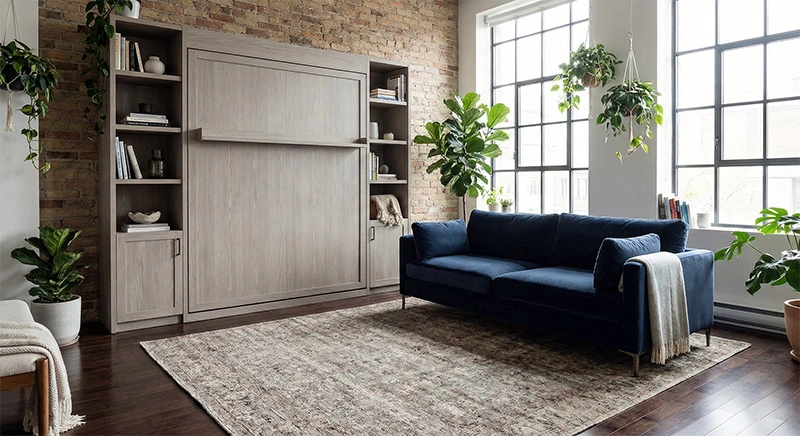
1. It Fits Your Life (and Your Doorframe)
If you live in a Montreal walk-up with those famous winding outdoor staircases, or a Vancouver condo with a tiny elevator, you know the panic of buying furniture.
Will a queen-sized sofa bed even fit through the door?
Often, the answer is no. A DIY wall bed solves this logistical nightmare. Because it arrives in flat-pack components, you can easily carry it through narrow hallways, tight corners, and up spiral stairs.
You assemble it exactly where it needs to live, bypassing the “will it fit?” anxiety entirely.
2. You Become the Architect
With a standard sofa bed, you are stuck with whatever dimensions the factory decided on. If it blocks a plug or sticks out too far, too bad. With a custom solution, you use an online configurator to design a unit that fits your room to the millimeter. You aren’t just buying a bed; you are designing a wall.
- Precision: Tailor the height and width to maximize your specific wall space.
- Storage: Add integrated wardrobes, shelving, or cabinets to replace other cluttering furniture.
- Style: Choose your handle finishes, colours, and mechanism types to match your decor, not clash with it.
3. The “Built-In” Look for Less
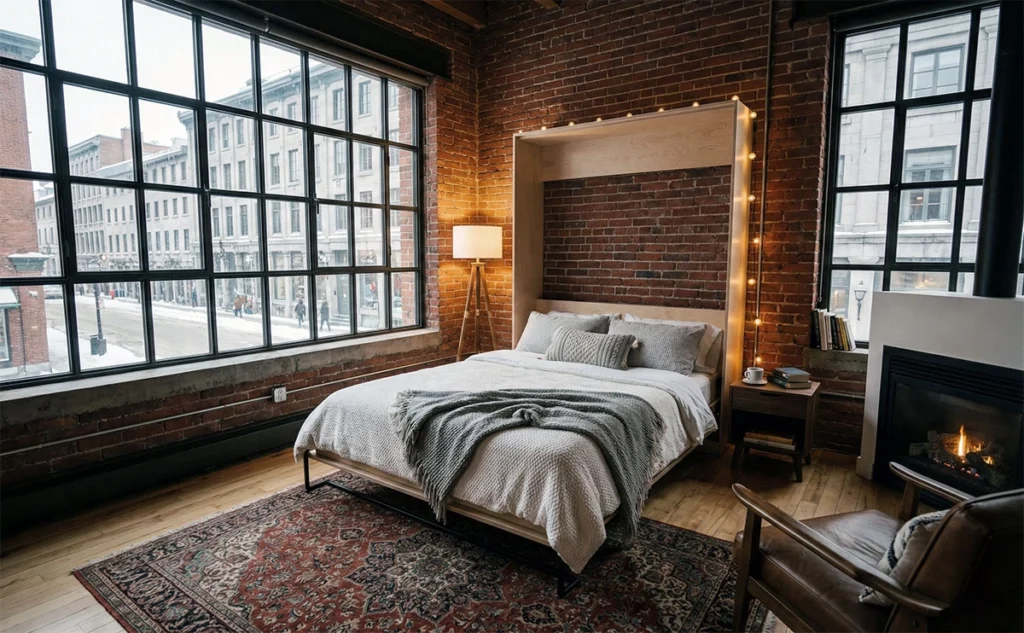
Custom millwork usually costs a fortune. By choosing a DIY kit, you are getting that same high-end, “built-in” aesthetic—where the furniture looks like part of the architecture—without paying for professional labour. You save money on installation and put that budget towards what really matters: a high-quality mattress.
The True Cost Comparison: Price vs. Value
While a sofa bed may appear cheaper upfront, comparing the two purely on price misses the long-term value and comfort you gain from a wall bed.
| Feature | Sofa Bed (Pull-out) | DIY Wall Bed Kit | Professionally Installed Wall Bed |
| Upfront Price | $400 – $1,500 | $1,200 – $3,500 | $4,000 – $7,000+ |
| Mattress Replacement | High (Proprietary sizing, often requiring unit replacement) | Low (Uses standard North American sizes from any brand) | Low (Uses standard North American sizes from any brand) |
| Cost Per Sleep | High (Poor sleep quality, short lifespan, constant mattress wear) | Low (Real mattress comfort, 15+ year lifespan, built-in value) | Low |
Quantifying the Space Value
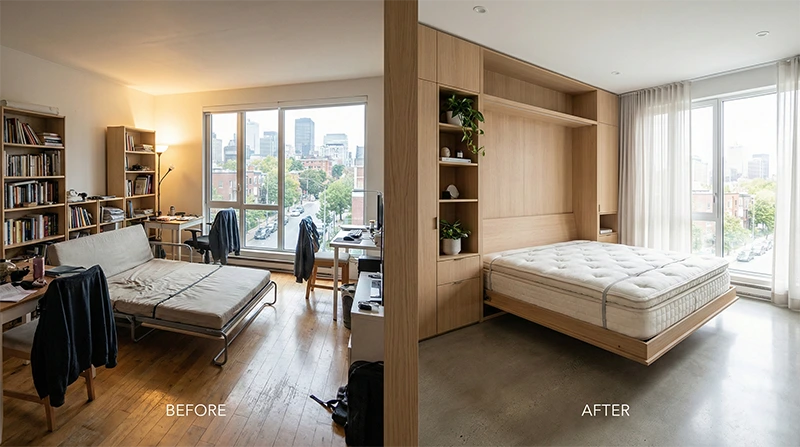
In major cities like Vancouver or Montreal, the cost of living is tied directly to square footage. By folding up, a Queen-sized Wall Bed recovers over 30 square feet of usable floor space during the day.
Over the 15+ year lifespan of the wall bed, this reclaimed space translates to a significant financial return that a stationary sofa bed simply cannot match. You are not just buying a bed; you are adding valuable, multi-functional space to your home.
Safety & Standards: Why “DIY” Doesn’t Mean “Risky”
When people hear “DIY Wall Bed,” two concerns usually pop up: “Is it safe to operate?” and “Am I locking myself into a weird, non-standard system?”
These are valid questions. However, high-quality US-made kits are engineered specifically to eliminate these risks. Here is why choosing a standardized, modern system is actually safer and smarter than buying a pre-built import.
1. The Safety Mechanics: It Won’t “Snap” Shut
We have all seen the old cartoons where a wall bed snaps shut with someone inside. In reality, modern wall bed physics make that impossible.
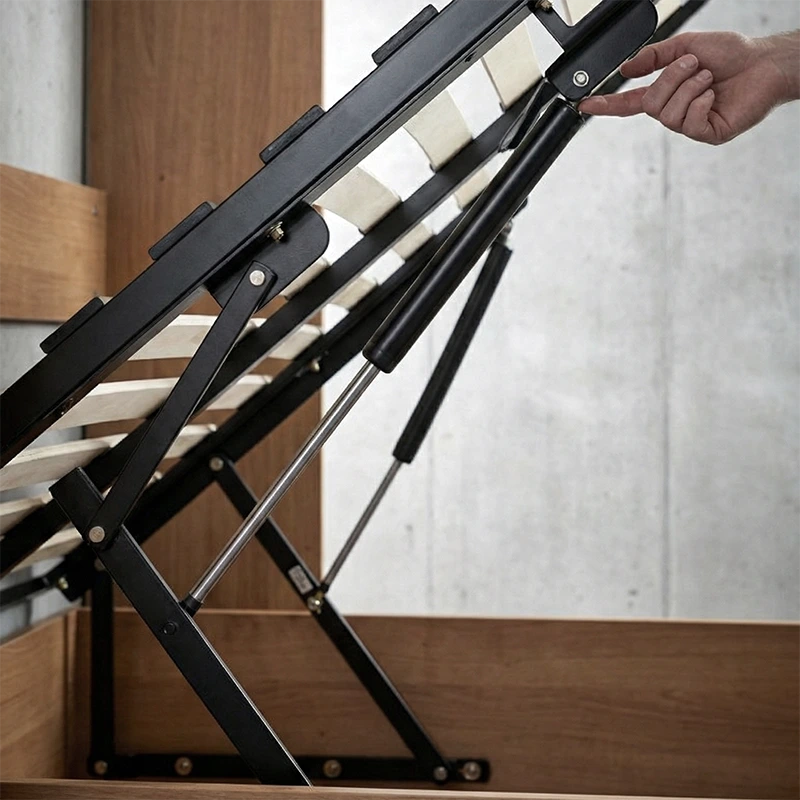
- Counter-Balanced Movement: Whether using a spring or piston mechanism, the bed is counter-balanced. This means the weight of the mattress is neutralized by the mechanism. If you let go of the bed halfway down, it doesn’t crash to the floor; it hovers.
- Soft Open & Close: High-end DIY kits feature dampened pistons or tension-adjusted springs. This ensures the bed glides open and requires very little force to lift—often easily manageable with one hand.
- Locking Legs: The leg support system on modern beds is designed to deploy automatically or manually lock into place, ensuring the bed cannot physically close while you are sleeping on it.
2. The Critical Importance of “Standard” Sizing
One of the hidden traps of buying a sofa bed or a cheap, imported wall bed is proprietary sizing.
Many European or Asian imports use “custom” mattress sizes (e.g., a “Double” that is 3 inches shorter than a Canadian Double).
When that cheap mattress inevitably sags after two years, you cannot just walk into a local mattress store to replace it.
You are stuck ordering an expensive custom replacement or scrapping the whole unit.
- The DIY Advantage: Our systems are built strictly to North American Standards.
- Standard Mattresses: You can use a standard Single, Double, Queen, or King mattress from any brand you trust (Endy, Casper, IKEA, Sleep Country, etc.). You are not married to our mattress forever.
- Right to Repair: We use industrial-grade, standardized hardware. If a piston eventually loses pressure in 15 years, you don’t need to replace the whole bed. You simply swap out the part.
3. Anchoring: The Key to Stability
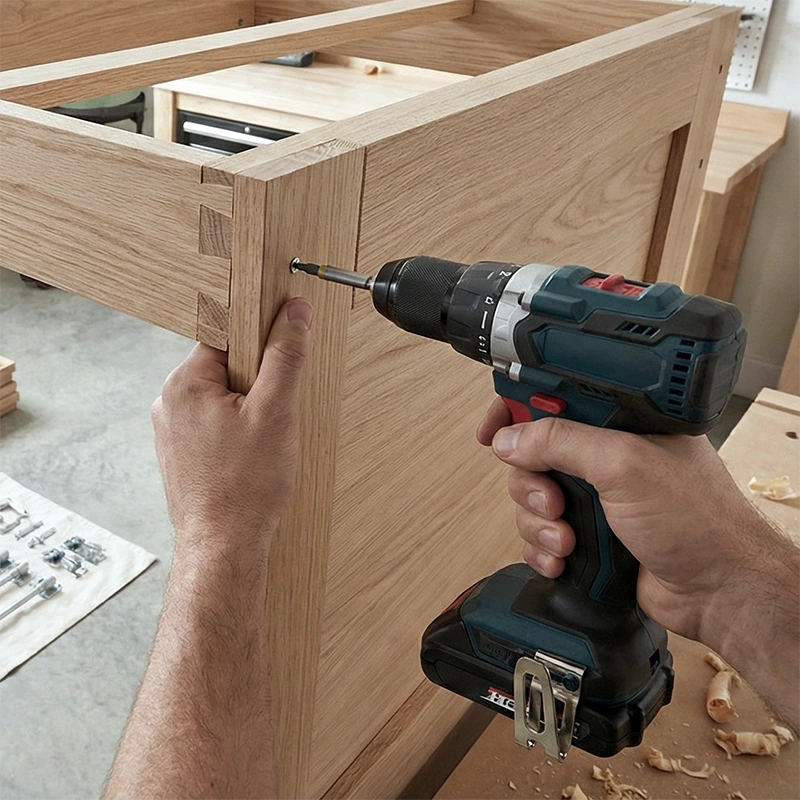
The only “risk” in a wall bed is improper installation, specifically regarding anchoring. However, a good DIY kit removes the guesswork.
- Stud-to-Stud Security: Unlike a freestanding wardrobe that might tip, a wall bed is bolted directly into the structural studs of your wall (wood or metal). Once anchored, the cabinet becomes part of the building’s structure. It is arguably safer and more stable than a heavy bookshelf.
Final Verdict: The Smart Choice for Your Home
So, when facing the Wall Bed or Sofa Bed decision, ask yourself this: Do you want a piece of heavy, temporary furniture that dictates how you use your room? Or do you want a custom solution that adapts to your space?
- The Sofa Bed: A bulky compromise that eats up floor space and offers mediocre sleep.
- The DIY Wall Bed: A permanent, space-saving upgrade that gives you a full bedroom experience without sacrificing your living area.
Don’t settle for “good enough.” Build a room that works for you, 24/7.
Ready to reclaim your space? [Design Your Custom Wall Bed Today!]
Frequently Asked Questions (FAQ)
Q: Can you use a regular mattress on a wall bed?
A: Yes! This is the main advantage of a wall bed vs. a sofa bed. You can use almost any standard coil or memory foam mattress, provided it meets the weight and thickness requirements of your specific mechanism (usually up to 10-12 inches thick).
Q: Are wall beds safe?
A: Absolutely. Modern wall beds use hydraulic pistons or spring-balanced mechanisms that make lifting and lowering the bed effortless and safe.2 When properly anchored to the studs in your wall, they are incredibly secure.
Q: Is it hard to assemble a DIY wall bed?
A: Not with the right kit. Modern custom wall bed kits are designed for the end-user. If you are comfortable using a drill and following instructions, you can assemble a professional-grade Murphy bed over a weekend.
Q: Which is better for small spaces: a vertical or horizontal wall bed?
A: It depends on your room’s shape.
- Vertical beds look more like traditional beds but require more length to open.
- Horizontal wall beds are ideal for narrow rooms or rooms with low ceilings (like basements).
Q: How much space does a wall bed save compared to a sofa bed?
A: A sofa bed always takes up the footprint of the sofa. A wall bed folds up completely, often tucking into a cabinet only 16-20 inches deep, recovering 30+ square feet of usable floor space during the day.