Modern Murphy Bed Design for Montreal Homes (2026)


Modern Murphy bed design has evolved far beyond the traditional wall bed. In 2026, homeowners in Montreal are choosing space-saving Murphy bed systems that seamlessly combine comfort, storage, workspaces, and contemporary interior design.
In 2026, the concept of the “dedicated guest room” in urban Quebec has officially shifted from a standard expectation to a rare luxury.
Between the normalisation of hybrid work-from-home (WFH) schedules and the rising cost per square metre in the city, residential spaces must perform double, triple, and sometimes quadruple duties. This spatial pressure has sparked a massive renaissance in modern Murphy bed designs.
Gone are the days of the clunky, spring-loaded 1980s pull-down beds that required the upper-body strength of an Olympic athlete to operate, threatening to swallow anyone who sat too close to the edge. The modern wall bed has evolved into an architectural chameleon—a marvel of high-precision millwork, counterbalanced pneumatic engineering, and modular customisation.
Table of Contents
Defining the Modern Murphy Bed Design
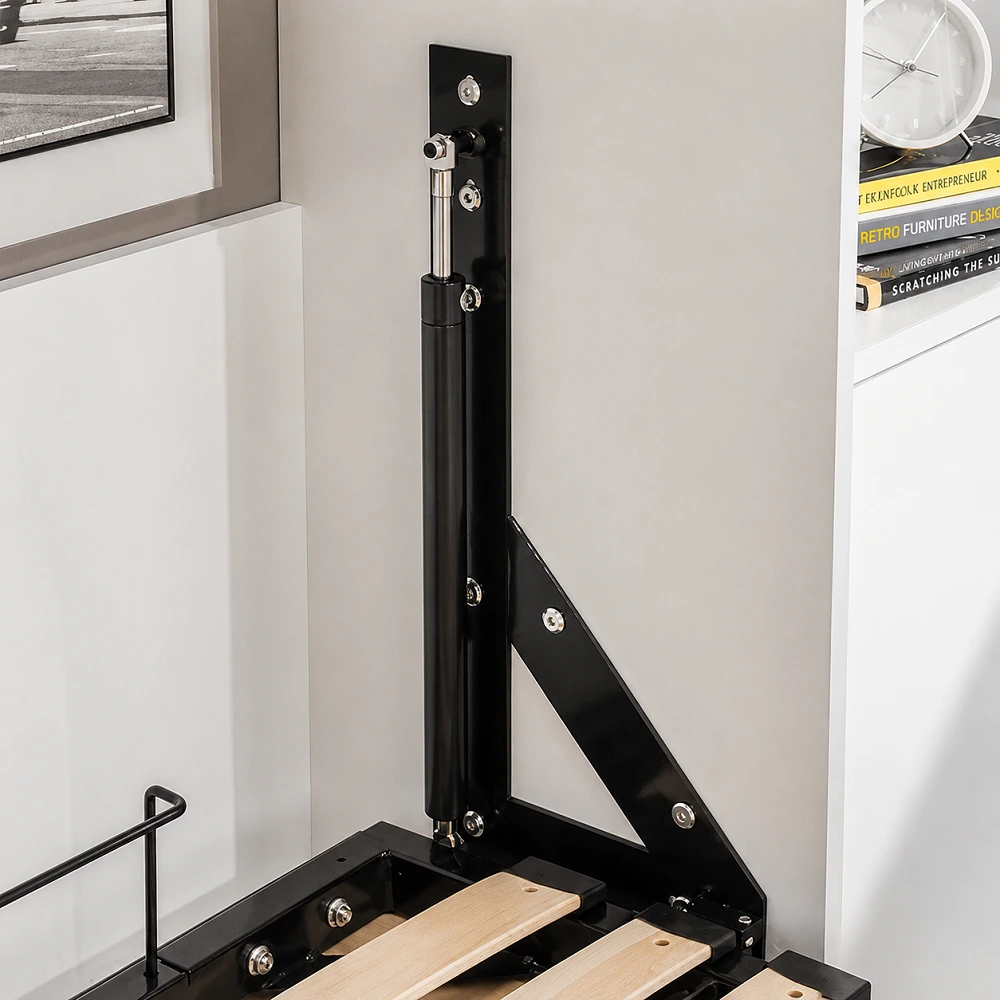
To understand the contemporary landscape of space-saving furniture, we must separate the traditional “wall bed” from a true modern Murphy bed design.
While both achieve the basic goal of clearing floor space by tilting a mattress vertically against a wall, the modern iteration is defined by three specific engineering and aesthetic upgrades:
A. Kinematic Balance & Pneumatic Pistons
Traditional systems relied on heavy, high-tension steel coil springs.
As these springs aged, they lost tension unevenly, resulting in beds that would either slam shut or drop dangerously fast. Modern designs utilise heavy-duty, dual-action gas struts (pneumatic pistons).
Calibrated specifically to the weight of the Canadian-standard mattress and the face panel, these pistons create a “zero-gravity” effect.
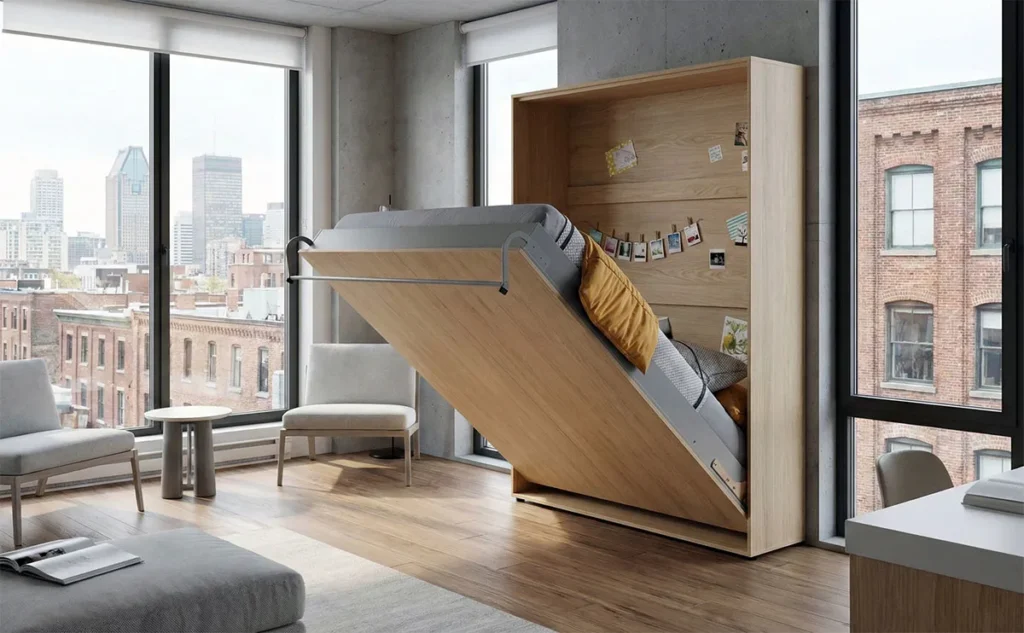
A modern Queen-size Murphy bed can be lowered or lifted with the gentle pull of two fingers. Furthermore, they feature soft-close dampening, ensuring the bed platform glides to a silent halt both on the floor and inside the custom millwork gable.
B. The Monolithic & Integrated Cabinetry (Millwork)
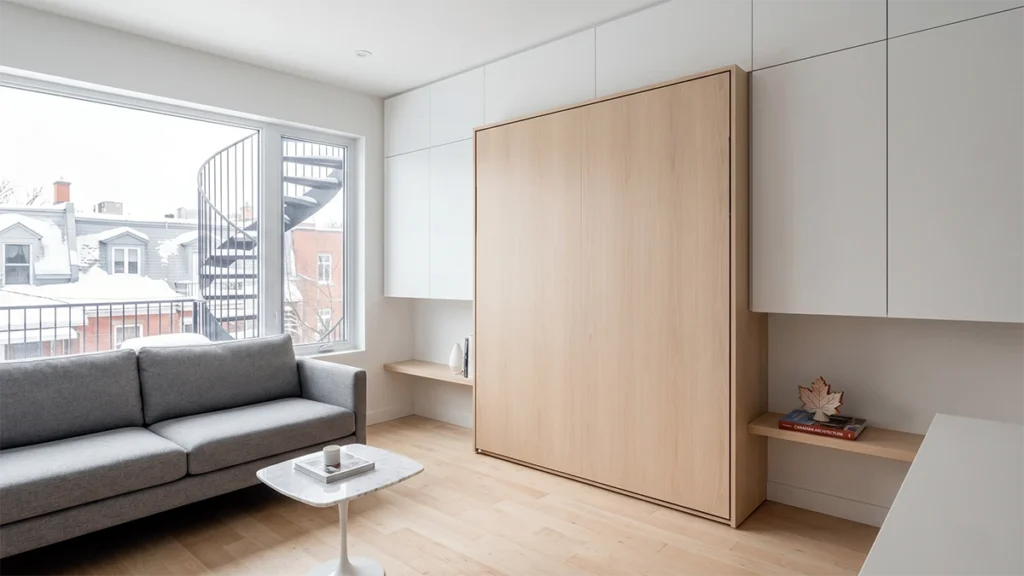
In standard 20th-century designs, the bed looked like a giant, suspicious wooden closet sitting awkwardly in the middle of a drywall partition. A true modern Murphy bed is conceived as an integrated architectural wall unit.
Utilising sleek European flat-slab doors, push-to-open mechanical latches (eliminating protruding handles if a minimalist look is desired), and seamless top-kick fascias, the closed bed becomes an elegant accent wall. It is designed to match surrounding kitchen cabinetry, living room media consoles, or custom office credenzas.
C. The Zero-Clearance Footprint
Modern urban design dictates that no space goes wasted. Advanced pivoting geometries now allow the bed frame to articulate outward without requiring the user to pull the unit away from the back wall.
The geometry accounts for standard Montreal baseboard moldings (typically 3 to 5 inches in historic builds), allowing the millwork to sit flush against the plaster or drywall without expensive structural modifications to the room’s perimeter.
2. The Montreal Architectural Challenge
Why Off-the-Shelf Fails?
When purchasing furniture for a Montreal home, standard mass-market retail options frequently result in logistical nightmares. The city’s unique housing stock presents rigid physical barriers that demand a highly modular, assemble-in-place approach.
| Montreal Moving Challenge | Modern Solution |
|---|---|
| Exterior spiral staircases | Flat-pack delivery |
| Narrow hallways | Modular components |
| Double-parlour layouts | In-room assembly |
| Difficult furniture transportation | DIY Murphy bed installation |
The “Plex” Staircase bottleneck
Anyone who has lived in Villeray, Rosemont, or Verdun knows the terror of moving day (historically July 1st in Quebec). Maneuvering a pre-assembled, rigid Queen-sized bed frame or a massive solid-wood headboard up a 65-degree exterior spiral staircase covered in light morning drizzle is practically a Montreal rite of passage.
Furthermore, once inside the front door, the internal corridors of classic split-level indivisible co-ownerships turn at sharp 90-degree angles.
The Modern Solution: Flat-pack modularity. Modern wall beds designed for the Canadian market are engineered to be delivered in manageable, weight-distributed flat cartons. The homeowner carries the individual gables, structural steel frames, and facade panels directly into the target room, bypassing the architectural bottlenecks entirely. The bed is assembled at the site of deployment.
The “Double-Parlour” (Pièce Double) Dilemma
A massive percentage of Montreal’s rental and heritage condo stock features the classic pièce double—a long, continuous rectangular layout divided in the centre by a wide structural archway, but lacking actual partition walls or standard bedroom doors. Residents are forced to figure out how to put a bed in a space that is entirely visible from the living room sofa.
Deploying modern murphy beds for small spaces inside a double-parlour instantly resolves this privacy and utility issue. By day, the front half of the apartment operates as an expansive, sunlit open-concept living and dining area. By night, the back wall unlatches to reveal a dedicated, highly comfortable sleeping quarter.
3. Typology Matrix: Montreal Housing vs. Wall Bed Solutions
To make the right structural choice, Montreal residents must match their specific architectural layout to the appropriate mechanical orientation:
| Montreal Housing Type | Average Room Width | Main Challenge | Recommended Murphy Bed |
|---|---|---|---|
| Historic Triplex | 8.5–10 ft | Narrow rooms, high ceilings | Vertical Queen Wall Bed |
| New Studio Condo | 11–12 ft | Single-room living | Murphy Bed with Couch |
| Converted Basement | Varies | Low ceilings and ductwork | Horizontal Murphy Bed |
| Loft Conversion | 15+ ft | Open layout without zones | Murphy Bed with Storage |
The Big Four: Transforming Living Areas into Sleeping Quarters
As the industry moved away from treating the Murphy bed as a standalone piece of wood, industrial designers began integrating it into complex, multi-functional furniture ecosystems. In modern Canadian interior design, we categorize these advanced systems into “The Big Four” primary hybrid configurations.
1. Modern Murphy Beds with Desk (The WFH Revolution)
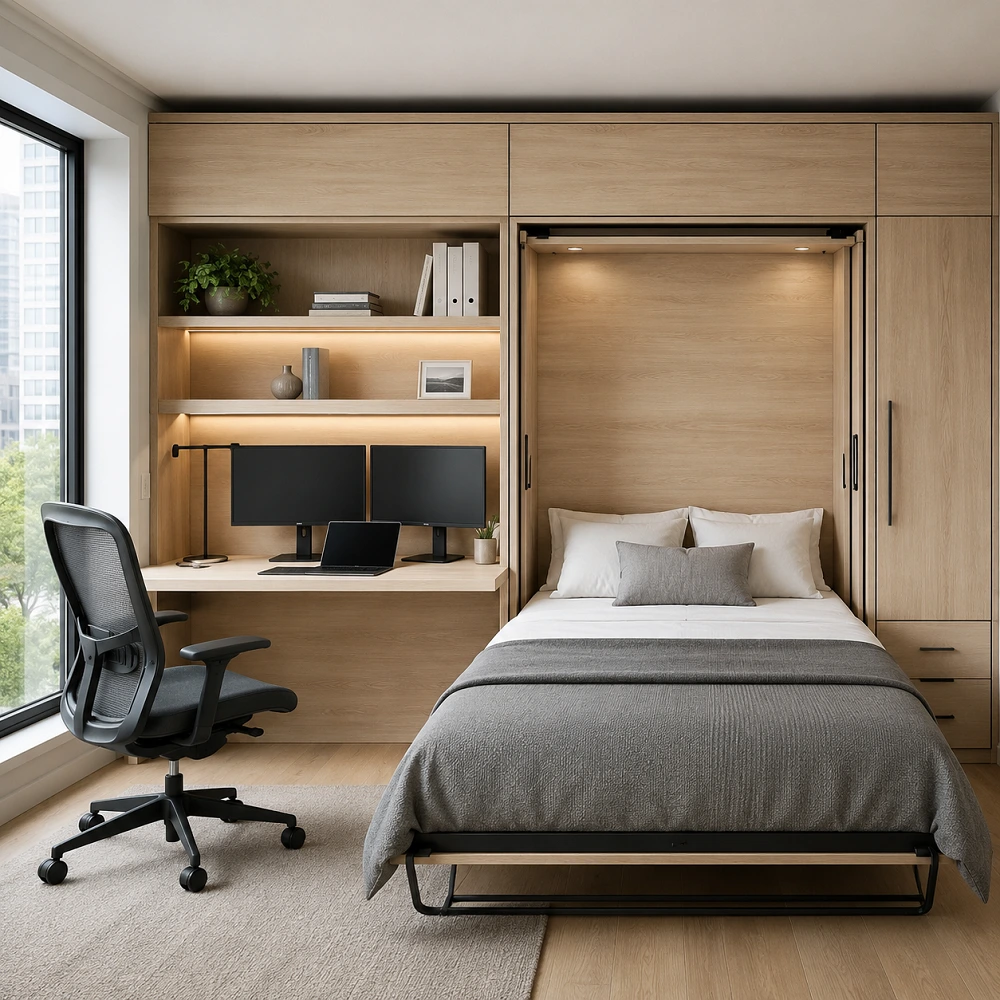
In neighborhoods like Rosemont–La Petite-Patrie and Outremont, the transition to hybrid work created an immediate crisis: where do you put the dual-monitor standing desk when your apartment only has one bedroom?
The modern murphy bed with desk system (often referred to as a “study-bed” or “desk-bed”) is the ultimate engineering triumph in residential multi-tasking. There are two primary schools of mechanical design for this configuration:
The Cantilevered Drop-Down Desk
In this premium setup, a massive work surface (often measuring 60 inches wide by 24 inches deep) sits on the outer face of the bed cabinet. When the user pulls the bed frame down, a sophisticated underlying mechanical linkage keeps the desk surface perfectly parallel to the floor throughout the entire 90-degree arc of motion.
The Practical Advantage: You do not have to clear your desk to go to sleep. Your laptop, dual 27-inch 4K monitors, external keyboard, coffee cup, and paperwork remain completely undisturbed, tucked safely in the clearance void beneath the suspended mattress platform. When you wake up, you lift the bed, and your office instantly reappears exactly as you left it at 5:00 PM the previous evening.
The Fold-Down Piston Worktop
For hyper-minimalist spaces where depth is strictly constrained, the desk consists of a secondary panel that folds up flush against the bed facade using heavy-duty drop-leaf locking hinges.
While this requires clearing the laptop before lowering the bed, it allows the entire closed unit to project a mere 16 to 18 inches from the drywall—an absolute godsend for narrow Montreal study dens.
2. Modern Murphy Beds with Couch (The Studio Anchor)
When configuring a 500-square-foot open-plan condo in Downtown Montreal, forcing a standard sofa and a standard Queen mattress into the same room instantly creates a claustrophobic, cluttered aesthetic.
You are perpetually walking sideways between the corner of your duvet and the armrest of your couch.
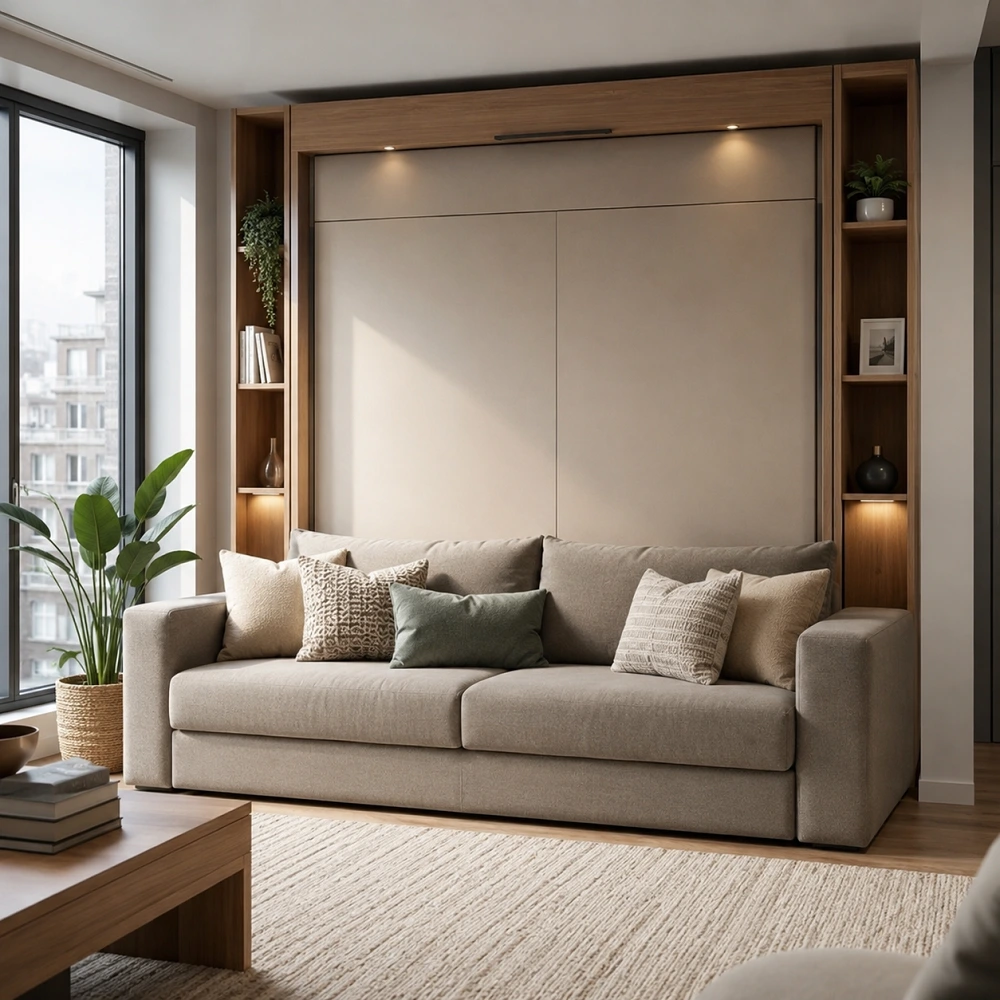
The modern murphy bed with couch eliminates the floor-plan battle entirely by superimposing both pieces of furniture onto the exact same footprint.
| Daytime Mode | Nighttime Mode |
|---|---|
| Wall cabinet remains closed | Wall bed is lowered |
| Comfortable sofa in use | Queen mattress fully deployed |
| Open living space | Dedicated sleeping space |
| Ideal for entertaining and work | Ideal for sleeping comfort |
How the Hybrid Architecture Works:
- The Integrated Frame: The custom couch is not an independent piece of furniture shoved against the wood cabinet; its sub-frame is mechanically locked into the lower kick-plate of the Murphy bed’s exterior millwork.
- The Disappearing Backrest: To deploy the bed, the user simply removes the two plush back cushions of the sofa (which are typically stored inside a hidden cavity beneath the sofa seat).
- The Bridge Descent: The bed platform unlatches and drops forward. The structural metal landing leg of the bed frame extends automatically, resting either on the floor just in front of the sofa or locking directly onto the reinforced solid-wood front rail of the sofa base itself. The mattress hovers millimeters above the upholstered seat cushions.
This setup offers an uncompromised sitting experience during the day—complete with deep seating depths, high-density foam, and premium textured linen or micro-velvet upholstery—and a completely uncompromised sleeping experience at night.
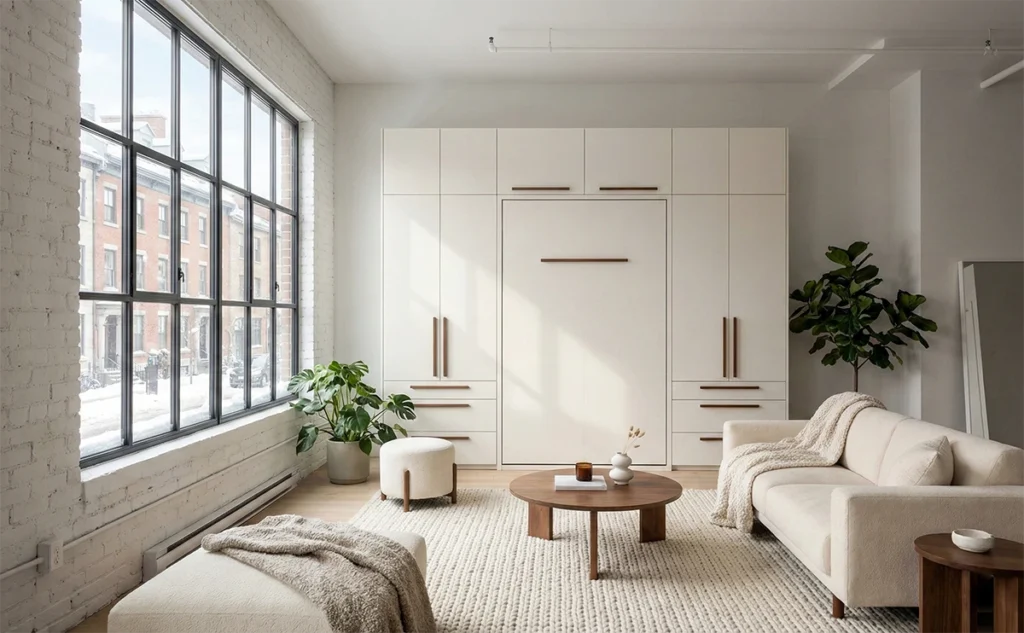
3. Modern Murphy Beds with Storage
To understand why modern murphy beds with storage are a core search trend in Quebec, one must look at a Montrealer’s front entrance in mid-January. You are dealing with heavy Canada Goose parkas, Sorel snow boots, thick wool scarves, salopettes, and salt-stained winter gear.
When spring arrives in May, all of that bulky, high-volume clothing needs to disappear for six months. Standard condo closets simply cannot swallow a Quebec winter wardrobe.
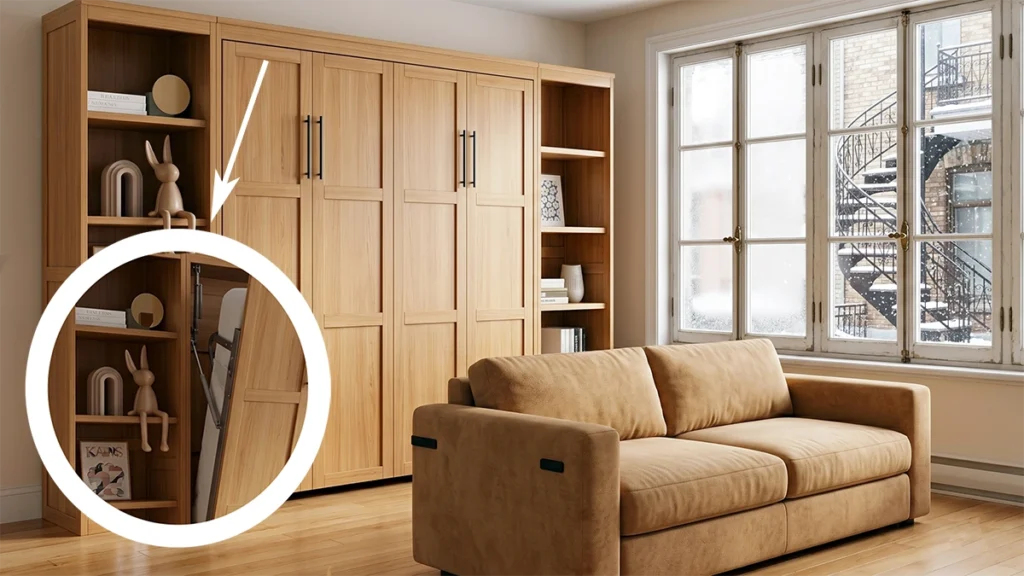
Modern modular storage systems turn the dead space on the left and right flanks of the bed cabinet into a highly organized, customisable millwork command centre.
The Side Gable Ecosystems
Rather than buying standalone dressers that disrupt the visual flow of the room, modern systems allow buyers to attach uniform, depth-matched modular side-cabinets directly to the central bed housing. These storage modules typically include:
- The Wardrobe Tower: A 24-inch or 36-inch wide cabinet featuring a heavy-duty chrome hanging rod at the top for winter coats and formal wear, situated above a bank of three or four deep, soft-close dovetail drawers for folded knitwear.
- The Open Display Shaker: A vertical column of adjustable glass or 1-inch thick wood shelving designed for curated books, vinyl records, or trailing indoor plants (like Pothos or Philodendrons), breaking up the heavy wooden mass of the cabinet.
- The Overhead Bridge (Soffit Cabinetry): For rooms with classic 9-foot ceilings, a horizontal row of top-hinged “lift-up” storage cabinets spans across the top of the bed unit and the side towers. This high-altitude storage is the ultimate designated zone for out-of-season duvet inserts, hard-shell travel suitcases, and winter sporting gear.
4. The Mattress Factor: Why “Modern Murphy Beds Queen” Rules
A common mistake made by first-time urban buyers is assuming that because their space is small, they must downgrade their sleeping comfort to a Double (Full) or even a Twin mattress. In the realm of contemporary modular engineering, modern murphy beds queen is the indisputable reigning standard.
The Dimensional Mathematics
A standard North American Queen mattress measures 60 inches wide by 80 inches long (approx. 152 cm × 203 cm). A standard Double measures 54 inches by 75 inches.
When you translate this to the folded, vertical wooden cabinet on your wall, the difference in the cabinetry’s footprint is negligible:
- Width difference on the wall: Only 6 additional inches of horizontal millwork.
- Projection into the room when open: Only 5 additional inches of floor extension.
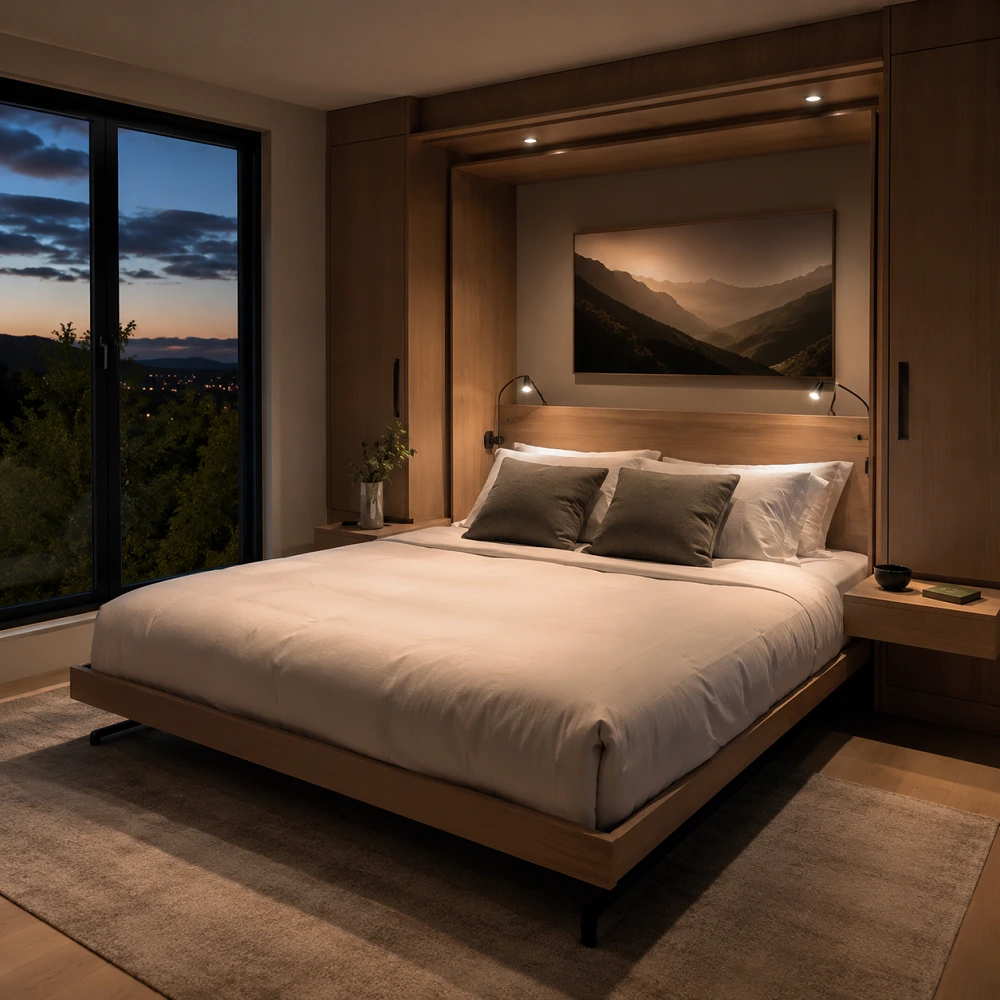
However, the psychological and physical difference of those extra inches for two adults sleeping through a frigid Canadian winter is monumental.
Because modern pneumatic pistons easily handle the extra 20 to 30 pounds of a Queen-sized mattress, there is zero operational penalty for choosing the larger bed.
Furthermore, custom modular wall beds are built to accommodate standard, premium mattress depths (up to 12 inches thick).
This means you can drop in a high-end, multi-layer pocket-coil or dense memory foam mattress directly from Casper, Endy, or Polysleep—no thin, painful “camper mattresses” required.
5. The Lighting & Nightstand Ecosystem
This reveals the biggest historical failure of old-school wall beds: The Cave Effect.
When you dropped an old Murphy bed, you found yourself trapped inside a dark wooden box.
You had nowhere to put your glass of water, your phone charger was dangling out of a wall outlet three feet away, and reading a book required getting up to flip the main ceiling light switch.
Modern design solves this through hyper-integrated micro-architecture:
| Integrated Feature | Purpose |
|---|---|
| LED Puck Lights | Soft overhead lighting inside the bed cavity |
| Articulated Wall Sconces | Directional reading light |
| Pull-Out Nightstand Trays | Space-saving bedside surface |
| Touch Controls | Easy lighting adjustment and dimming |
A. Integrated Recessed LED Puck Lights (The “Bedside Lights”)
During the millwork manufacturing process, the top horizontal header panel of the bed cavity is routed out to accept low-voltage, ultra-slim LED puck lights. Wires run invisibly behind the inner backing panel down to an integrated smart transformer.
These lights operate via a capacitive touch sensor seamlessly embedded into the wooden headboard panel—tap the wood once to turn them on, hold your finger on the wood to dim them down to a warm 2700K glow before sleep.
B. Articulated Sconces (The “Bedside Lamps”)
For those who prefer directional reading light, modern wall bed cavities feature reinforced side-gables pre-drilled for low-profile, matte black or brushed brass articulated wall sconces. These lamps feature flexible goosenecks or swiveling dual-axis arms that can be pushed completely flat against the cabinet wall before the bed is pivoted shut.
C. The Slide-Out Floating “Bedside Table”
Because a traditional nightstand sitting on the floor would block the swing path of the Murphy bed’s exterior facade, modern engineering utilizes integrated pull-out nightstand trays. Operating exactly like a breadboard pull-out in a high-end kitchen, a smooth melamine or solid-wood tray glides out from a hidden slot inside the adjacent storage towers.
It sits at the exact ergonomic height of the mattress platform, providing a sturdy, reliable surface for your smartphone, a glass of water, and your spectacles. When morning comes, you slide it back into the millwork, leaving a completely flush, unblemished cabinet face.
Customization, Materiality, and the DIY Assembly Advantage
Navigating the logistics of space-saving furniture requires more than just picking a pretty picture from an online catalog. It demands an understanding of material science suited to the Canadian climate, local structural realities, and modern distribution models.
Material Science of the North: Surviving the Quebec Climate
Montreal experiences some of the most violent indoor atmospheric swings in North America. In July, ambient indoor humidity can easily cross 75% during a heatwave; by February, heavy cast-iron hot-water radiators or forced-air electric baseboards strip indoor humidity down to a bone-dry 20%.
If you buy a cheaply manufactured wall bed made of low-grade, porous particleboard with paper-thin foil wrapping, the mechanics will fail within three winters. The wood will expand, bow, and warp, throwing the high-precision pivot points out of alignment and causing the gas pistons to bind.
The Montreal Material Standard:
- High-Density Thermal Fused Melamine (TFM): The gold standard for modern Canadian wall beds. Built on a core of industrial-grade, 100% recycled wood fibers compressed at extreme pressures, TFM panels are clad in a resin-impregnated decorative paper that is thermally fused directly to the core. It is completely impervious to moisture fluctuations, resists scratching from pets, and will not discolour under the harsh UV rays pouring through tall Montreal condo windows.
- Textured Woodgrains & Super-Mattes: Aesthetically, the market has shifted entirely away from glossy, plasticky whites. The top trending finishes for 2026 in Montreal are deeply textured, synchronized woodgrains (such as Natural Rift Oak, Smoked Walnut, and Nordic Ash) that mimic the tactile feel of real lumber, alongside anti-fingerprint super-matte lacquers in muted earth tones (Sage Green, Warm Taupe, and Charcoal).
- Heavy-Gauge Tubular Steel Sub-Frames: The internal skeleton supporting the mattress must never be pure wood. Premium units feature a continuous, robotically welded steel perimeter frame with integrated arched beechwood slats. This ensures the platform never sags in the middle, even after a decade of daily usage.
2. An Engineer’s Guide to Wall Fastening
Authoritative Note: A modern Murphy bed is a dynamic moving machine storing immense potential energy. Improper installation can result in catastrophic drywall failure, severe property damage, or serious personal injury. Always adhere strictly to the manufacturer’s torque and anchoring guidelines.
The single most critical step in deploying a wall bed is the mechanical anchor connecting the top header of the millwork to your home’s permanent physical structure. In Montreal, your anchoring strategy must change based on the era of your building:
Scenario A: The Century Home (Lath and Plaster)
If your apartment was built before 1940 (common in Le Plateau, Mile End, Westmount, and Saint-Henri), your walls are likely traditional lath and plaster. Standard plastic drywall toggles or basic screw anchors will rip straight out of the horsehair plaster the first time you pull the bed down.
- The Engineering Fix: You must locate the true structural vertical wall studs (rough-sawn 2x4s sitting behind the horizontal wooden lath strips). Because old studs are rarely spaced at the modern 16-inch on-centre standard, you must use a deep-scanning magnetic stud finder to locate the iron nails holding the lath to the timber. Secure the bed’s steel mounting ledger to the wooden studs using 3.5-inch #10 structural wood screws with heavy load-distributing washers.
Scenario B: The Modern Condo (Steel Studs)
If you live in a high-rise tower built after 2005 (common in Griffintown, Nun’s Island / Île-des-Sœurs, and Downtown), your building code dictated the use of non-combustible light-gauge steel studs behind the drywall. Standard wood screws will spin uselessly inside the thin sheet metal.
- The Engineering Fix: You cannot rely on friction. You must use heavy-duty Snaptoggle® toggle bolts (1/4″-20 solid steel machine screws). You drill a 1/2-inch hole cleanly through the drywall and the center of the steel stud flange, slide the solid steel bar through the void, zip the retaining collar flat against the drywall, and torque the machine bolt down. This creates a steel-on-steel clamping force that distributes the 150-pound pull-force of the bed across the entire vertical metal column.
3. The Online Modular Revolution: Designing & DIY Assembly
Historically, buying a custom Murphy bed in Quebec meant visiting a dusty showroom in an industrial park in Laval or the South Shore, dealing with high-pressure sales reps, and waiting 12 to 16 weeks for expensive professional carpenters to come hack up your apartment walls.
In 2026, the consumer paradigm has completely inverted toward a direct-to-consumer (DTC), digital-first customiser model.
The Modern Purchasing Workflow:
- The Online 3D Configurator: Sitting in your living room with a tape measure, you log onto a local Montreal manufacturer’s web portal. You input your exact ceiling height, baseboard height, and available wall width down to the millimetre.
- Modular Customisation: You drag-and-drop your configuration. You select a Vertical Queen Bed in Smoked Oak, attach a Drop-Down Desk to the front face, add a Wardrobe Tower to the left flank, and select Integrated Touch LED Lights. The software instantly recalculates the price and generates photorealistic 3D renders of your exact room.
- Local Production & Flat-Pack Delivery: Because the business operates locally within the Greater Montreal Area, the custom panels are precision-cut on automated CNC routers at a local workshop. Within days, flat, highly protected cardboard parcels are delivered to your door.
- The Weekend Assembly: Armed with nothing more than a standard cordless drill, a level, and a set of metric Allen keys, the end-user follows step-by-step 3D interactive digital instructions (often via a companion mobile app). The bed is assembled and anchored in a single Saturday afternoon. You save thousands of dollars in installation labor, and you gain the profound, deeply satisfying pride of having built your own architectural transformation.
FAQ
To resolve the core semantic search entities surrounding wall beds in Canada, we have compiled definitive answers to the six most pressing questions asked by modern consumers:
Are modern Murphy beds comfortable enough for everyday use?
Yes, absolutely. The comfort of a wall bed is 100% determined by the quality of the mattress you place inside it. Unlike folding couch-beds (sofa sleepers) or futons that force you to sleep on segmented, thin foam sitting over painful metal support bars, a modern Murphy bed accommodates standard, premium continuous mattresses up to 12 inches thick. If you put an orthopedic, high-end hybrid pocket-coil mattress inside a Murphy bed, it will feel identical to sleeping on a standard luxury platform bed.
How much weight can a modern Queen-size Murphy bed hold?
A properly engineered, steel-frame modern Queen Murphy bed is designed to support a static weight capacity ranging between 1,000 to 2,000 pounds (approx. 450 to 900 kg), including the weight of the mattress itself. The pivoting structural metal legs lock firmly onto the floor, distributing heavy loads directly into the subfloor. It is exceptionally sturdy and easily accommodates two heavy adults, pets, and dynamic movement.
Can I leave my sheets, heavy duvet, and pillows on the bed when I close it?
Yes, with minor caveats. Modern cabinetry is intentionally engineered with a internal clearance void (usually 2 to 3 inches of air space between the top of the mattress and the inner back panel of the cabinet). You can easily leave your fitted sheet, flat sheet, and a standard down or microfiber duvet strapped down using the integrated elastic nylon retaining straps. However, plush, overstuffed sleeping pillows or bulky decorative throw pillows will usually need to be tossed into a side storage drawer before tipping the unit vertically.
Do I need special permission from my landlord to install a Murphy bed in a Montreal rental?
Because proper installation requires driving structural screws or toggle bolts into the wall studs, it is legally considered a permanent fixture modification. Under the Tribunal administratif du logement (TAL) rules in Quebec, you should always secure written consent from your landlord prior to installation. However, landlords are almost universally receptive to modern units because:
1. When uninstalled properly upon moving out, the resulting 1/4-inch anchor holes can be easily patched with standard polyfilla, sanded, and touched up with white paint in ten minutes, leaving zero structural damage.
2. They solve space issues, making the unit more livable.
What happens if the gas pistons fail while the bed is open or closed?
Modern commercial-grade nitrogen gas struts have an operational lifespan of roughly 10,000 to 15,000 full open-and-close cycles (roughly 25 to 30 years of daily usage). However, if a seal were to fail prematurely:
* If it fails while open: The bed simply stays on the floor resting safely on its structural legs. It will just feel significantly heavier to lift back up.
*If it fails while closed: Modern units feature secondary positive-locking physical latches (either magnetic or mechanical spring catches) at the top of the cabinetry. The bed cannot “fall out of the wall” autonomously; it remains securely locked inside the millwork until you manually release the face panel latch.
Can a Murphy bed be moved to a new home if I relocate?
Yes, entirely. This is the primary financial advantage of investing in a modular, flat-pack system over custom built-in drywall alcoves. To move the bed, you simply detach the gas pistons, unthread the upper wall-anchoring screws, and reverse the DIY assembly process. The unit breaks back down into flat, transportable wooden panels that can easily fit inside a standard Discount or U-Haul moving truck, ready to be reassembled in your next home.