
Why a Custom DIY Wall Bed in Montreal Beats IKEA?


Staring at a floor plan where a standard bed eats your entire room is a familiar Montreal struggle. If you’re hunting for a custom DIY wall bed in Montreal, you’ve likely realized that generic, one-size-fits-all solutions from big-box stores simply can’t handle our city’s unique architectural quirks—from narrow Plateau duplexes to compact Griffintown condos.
For decades, the default fix has been a trip to the big blue-and-yellow store. We know the routine: wrestling flat-pack boxes and hoping the thin particleboard doesn’t chip before you get home. But a Murphy bed is a mechanical investment, not a coffee table.
At iZi lit, we’ve bridged the gap between flimsy pre-fabs and overpriced custom millwork. Our “Design Online, Build Yourself” model gives you the precision of industrial CNC cutting with the pride and savings of DIY assembly.
The reason more Montrealers are choosing the custom DIY wall bed path lies in three critical areas: The Montreal “Fit,” Material Integrity, and Long-term Safety.
Table of Contents
Why Standard Sizes Fail Local Homes?
Montreal homes are beautiful, but they are rarely “standard.”
- The Pre-fab Problem: Ready-made wall beds from big retailers come in fixed dimensions. If their queen unit is 65 inches wide and your alcove is 64 inches, you are out of luck. Furthermore, mass-produced beds rarely account for the vertical limitations found in some basement suites or the awkward bulkheads common in new condo builds.
- The Custom Solution: Our online design tool allows you to input your exact requirements. Do you have a specific ceiling height? Do you need the bed to clear a baseboard heater? By customising the dimensions, you aren’t just buying furniture; you are adding architectural value to your home. You transform a “dead” wall into a functional bedroom without wasting a single centimetre.
Particleboard vs. High-Grade Melamine & Plywood
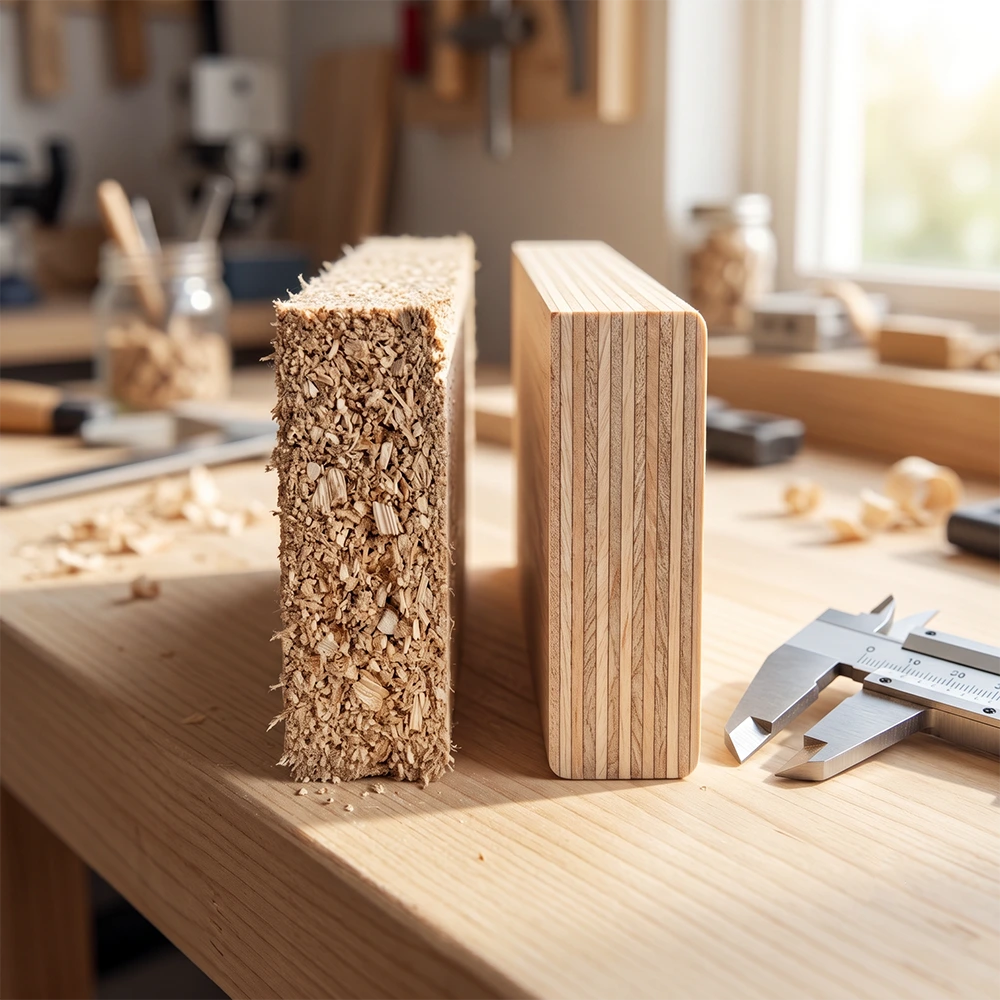
This is the most significant factor affecting your furniture choice.
The “Cardboard” Core of Fast Furniture
Most pre-designed wall beds (including popular IKEA models) rely heavily on low-density particleboard.
- The Issue: Particleboard is essentially sawdust glued together. It is heavy, but it lacks structural tensile strength.
- The Risk: A wall bed relies on screws and hinges to pivot hundreds of pounds of weight. Over time, the movement widens the screw holes in particleboard. This “wallowing” effect causes hinges to loosen, doors to sag, and eventually, mechanisms to fail. In Montreal’s humid summers and dry winters, particleboard swells and shrinks, accelerating this damage.
The Structural Integrity of Local Manufacturing
In our Montreal workshop, we prioritise longevity. When you design your bed with us, the core materials are different.
- Commercial Grade Melamine & Plywood: We use high-density materials designed for joinery and millwork. These materials hold screws tightly, year after year.
- Weight Distribution: Because you are assembling the unit yourself (DIY), the components are designed to be robust enough to handle handling, yet precise enough to fit together perfectly.
- Scratch & Moisture Resistance: Our finishes are selected to withstand real life—pets, kids, and the occasional spilled coffee—far better than the paper-thin veneers found on budget options.
The Mechanism: The Heart of the Bed
You can have the nicest looking wood panels, but if the lift mechanism is cheap, the bed is a burden.
The “Heavy Lifting” Myth Many generic wall beds use simple spring systems that are notoriously difficult to adjust and can become noisy (“squeaky”) over time. Worse, if a spring snaps, it can be a safety hazard.
The Piston Advantage When you customise your bed through our platform, you are selecting a system that uses high-quality gas pistons (or advanced spring systems depending on selection).
- Smooth Operation: These mechanisms are calibrated to the weight of your specific mattress and bed frame size.
- Safety: They prevent the bed from slamming down and make lifting it back up effortless—often requiring just one hand. This is crucial for elderly relatives or daily use in a studio apartment.
Addressing the “IKEA Hack” Trend
A popular search term in home decor is the “IKEA Hack”—taking a standard unit and trying to make it look built-in. While creative, this is often a trap when it comes to wall beds.
- Safety Hazard: Modifying a structural piece of furniture like a wall bed to “fit” a space it wasn’t designed for voids warranties and can compromise the mounting points.
- False Economy: By the time you buy the unit, buy the extra trim, buy the paint, and spend the weekend hacking it together, you have often spent more time and money than if you had ordered a custom-sized wall bed kit designed to fit perfectly from the start.
Why “Local” Means “Better” for Montrealers
When you order a pre-made bed from a global chain, it has likely travelled from a factory in Asia to a warehouse in Europe, then to a distribution centre in Toronto, and finally to Montreal. The carbon footprint is massive.
By choosing a Montreal-made DIY wall bed kit, you are:
- Reducing Carbon Emissions: Your bed is cut and prepped right here in the city.
- Supporting Local Craftsmanship: You are paying for skilled labour and quality materials, not international shipping logistics.
- Getting Weekend Support: Since we operate locally, if you have a question during your weekend assembly, you aren’t calling a generic 1-800 number; you are dealing with a team that understands the product inside out.
Designing for Your Life, Not a Warehouse
In Part 1, we discussed why the structural core of a custom wall bed outperforms the particleboard found in big-box stores. But durability is only half the battle. The other half is livability.
When you walk into a store like IKEA, you are presented with a “finished” product. You have to hope that their idea of style matches your decor, and more importantly, that their dimensions match your room. In a city like Montreal, where a Victorian triplex in the Plateau has completely different needs than a new-build condo in Griffintown, “one size fits all” usually means “one size fits nothing.”
This is where the power of our Online Design Tool changes the game.
The Power of “pixel-perfect” Customisation
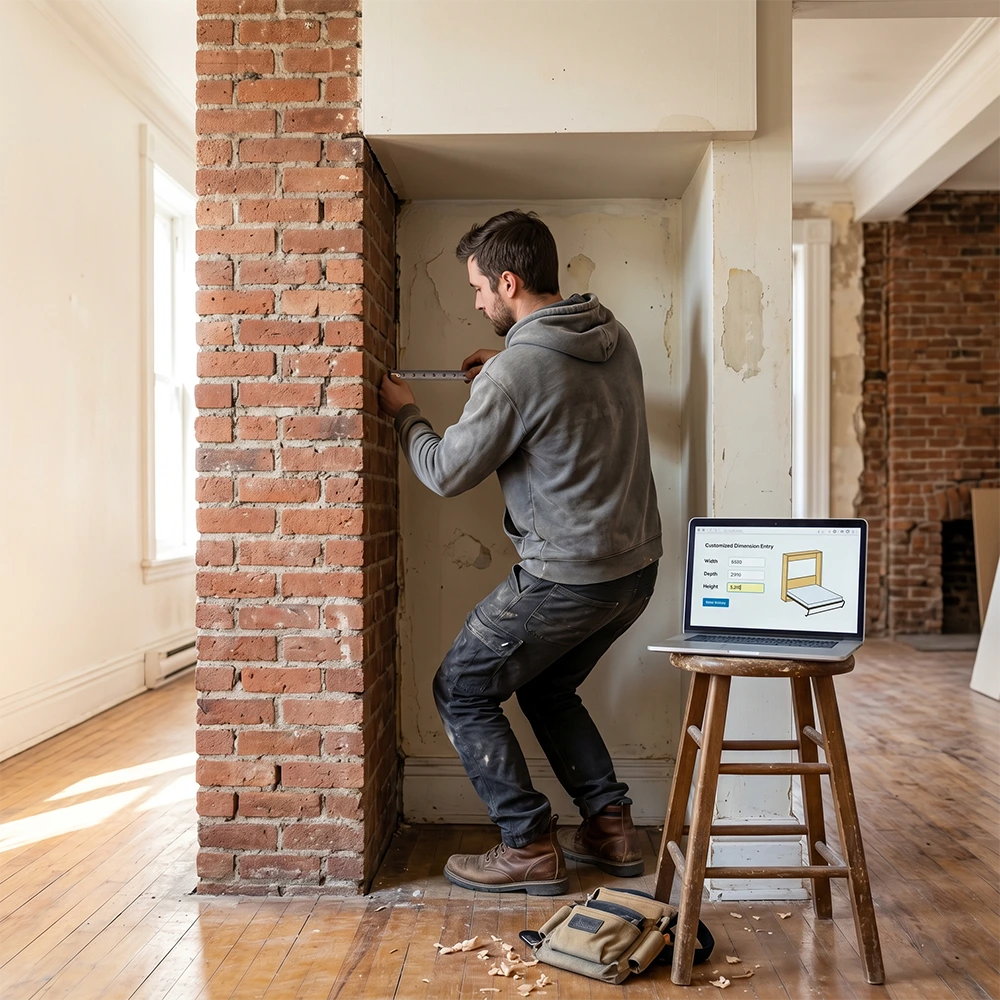
Most people assume that “custom furniture” means hiring an expensive interior designer and waiting 12 weeks for a carpenter to call you back. We have democratised this process.
Our interactive online tool puts the carpenter’s pencil in your hand. It allows you to visualize the unit in real-time, ensuring that what you see is exactly what you get.
A. Dimensions That Actually Fit
Standard wall beds often leave awkward gaps. A 6-inch gap between the bed and the wall isn’t just wasted space; it’s a dust trap.
- The Custom Edge: You input your available width, height, and depth. Whether you are trying to fit the unit snugly into an alcove or align it perfectly with an existing bulkhead, you control the geometry.
B. Aesthetic Integration: Colours and Finishes
A wall bed is a massive piece of furniture. When it is closed (which is most of the day), it effectively becomes a wall.
- Big Box Limitation: You typically get two choices: White or Black-Brown. If you have grey flooring or warm wood accents, you are forced to mismatch.
- Your Choice: Our platform offers a wide palette of Canadian-market standard laminates and finishes. You can match the bed to your existing wardrobe, your flooring, or make it a statement piece with a bold trend colour.
C. The Devil is in the Details: Handles and Hardware
It’s often said that handles are the “jewellery” of cabinets.
- Selection: We offer a curated range of handles—from modern matte black bars to classic brushed nickel—allowing you to match the bed’s hardware to your room’s door handles or light fixtures. This subtle coordination is what makes a room look professionally designed rather than “furnished by a catalogue.”
Maximising Vertical Real Estate: Side Cabinets & Storage
In Montreal apartments, closet space is a myth. This is why a standalone wall bed is often not enough. You need storage.
When you buy a pre-designed bed, adding storage usually means buying separate bookcases that sit next to the bed. They rarely flush up perfectly, creating visual clutter and wasted gaps.
The Integrated Solution: Through our design tool, you can add:
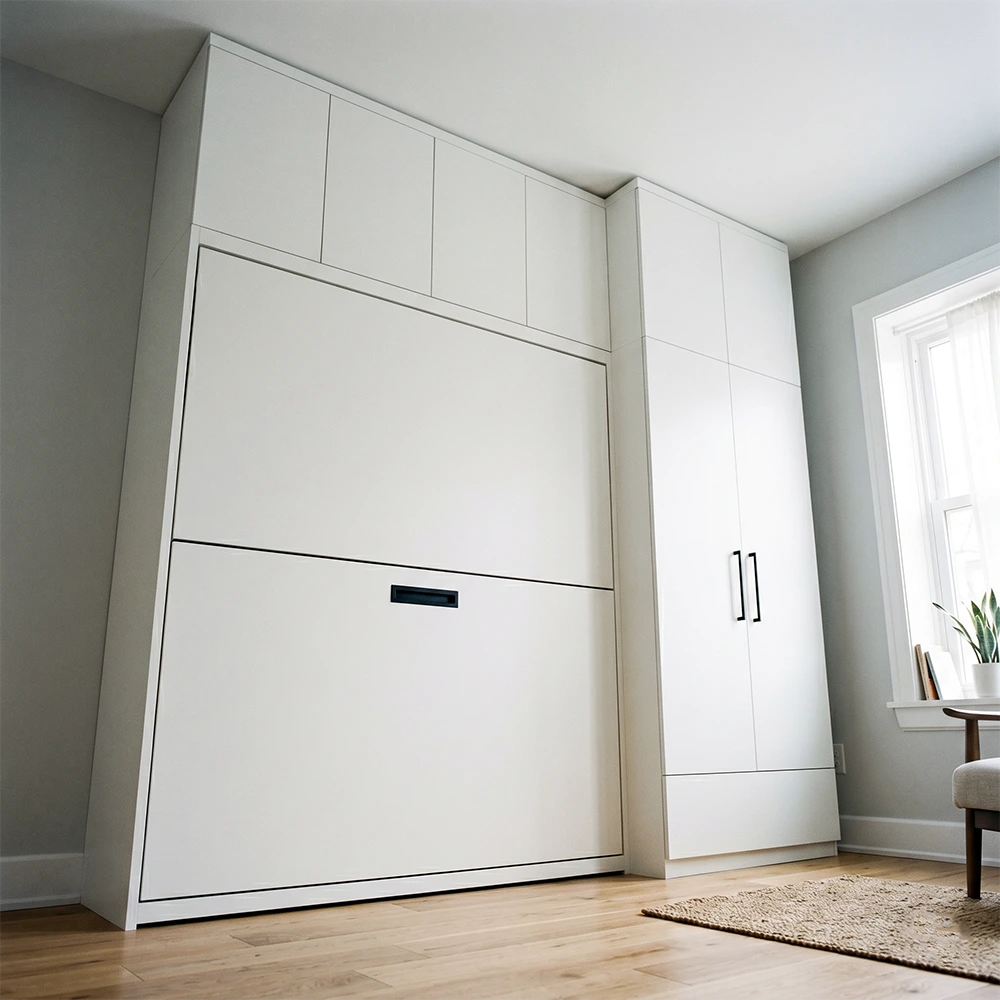
- Wardrobe Towers: Full-height cabinets for hanging clothes—perfect for studio apartments lacking a closet.
- Nightstand Nooks: Integrated shelving inside the unit or on the side, offering a place for your phone and a glass of water without needing a separate table on the floor.
- Overhead Storage: Using the space above the bed (often dead space in standard units) for seasonal items like winter coats or extra bedding.
Because these are manufactured as part of the same system, the joinery is seamless. It looks like built-in architecture, increasing the perceived value of your condo.
The DIY Assembly: Empowering, Not Exhausting
We know what you are thinking. “I don’t want to build a bed. I still have trauma from that IKEA dresser in 2018.”
We get it. But we have approached DIY (Do-It-Yourself) differently. We view the assembly not as a chore, but as the final step of the design process.
The frustration with mass-market furniture often comes from poor tolerances. Holes don’t line up, screws strip, and instructions are vague cartoons.
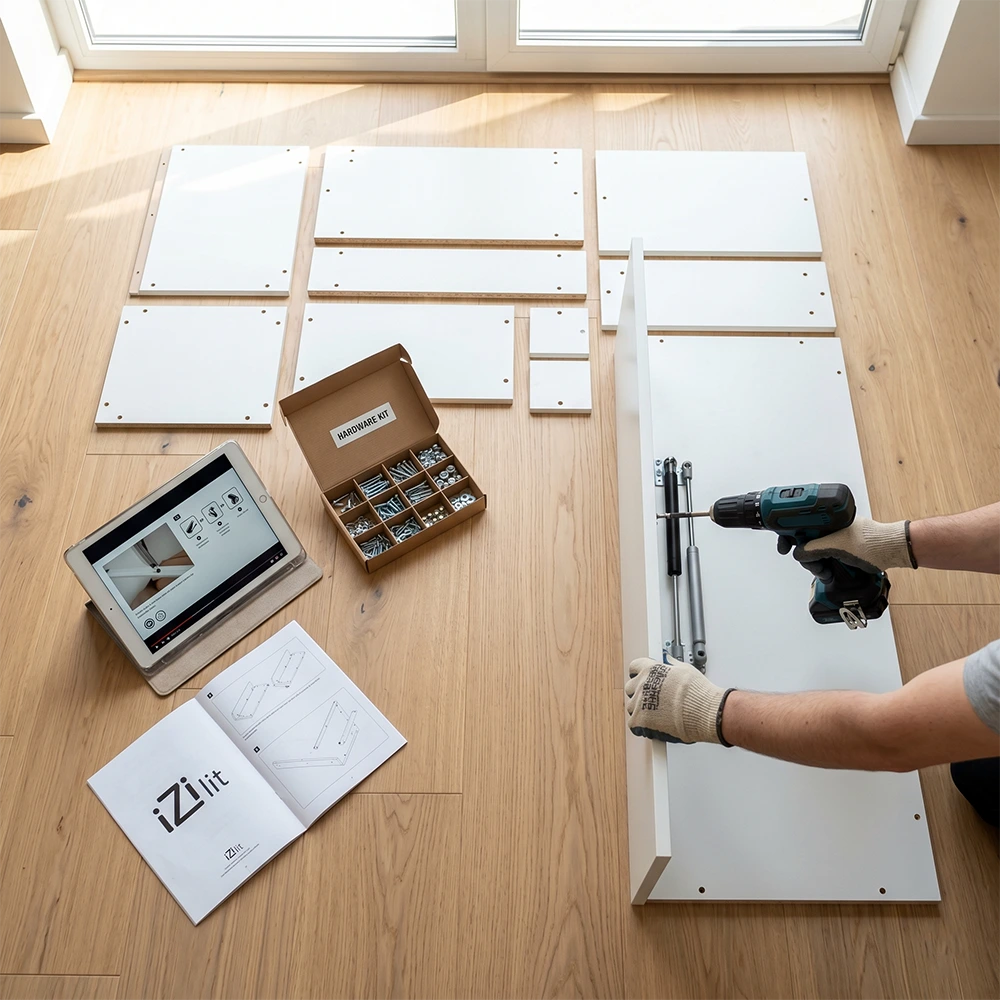
A. Commercial Grade Engineering, Consumer Level Assembly
- Precision CNC Cutting: Because your bed is cut right here in Montreal using industrial CNC machines, the precision is within a fraction of a millimetre. Parts fit together with a satisfying “click.”
- Better Hardware: We use cam-locks and fasteners that are industrial grade. They are easier to tighten and hold significantly more tension than standard retail hardware.
B. The “Sweat Equity” Savings
By handling the assembly yourself, you are unlocking massive value.
- Where your money goes: With a traditional custom cabinet maker, 30-40% of the cost is installation labour. With big-box stores, you pay for international shipping and brand markup.
- Where it goes with us: Since you are assembling it, we can put 100% of your budget into better materials. You are getting a $5,000 quality bed for a fraction of the price because you are willing to spend a Saturday afternoon putting it together.
C. We Are Your Neighbours (Support)
If you get stuck building an IKEA bed on a Saturday, there is nobody to call.
- Local Support: Since we are a Montreal-based team, we are in your time zone. We provide clear, video-based instructions, and if you truly get stuck, real help is just an email or call away. We want you to succeed because your beautiful finished bed is our best advertisement.
Safety First: The Mechanism Choice
Finally, the design tool allows you to select the type of lifting mechanism. This is a critical safety feature often overlooked in pre-fab comparisons.
- Standard Springs vs. Adjustable Pistons: Cheaper beds use springs that can snap or stretch. We offer adjustable mechanisms that allow you to “tune” the lift. Did you buy a heavier memory foam mattress? You can adjust the tension so the bed still lifts with one finger. This level of customisation ensures that the bed remains safe and easy to use for everyone in the household, from teenagers to seniors.
Logistics: The “Montreal Reality” Check
If you have ever tried to order a specific piece of furniture from a global retailer during peak moving season (July 1st), you know the pain. “Out of Stock” notifications, vague delivery windows between 8 AM and 8 PM, and the anxiety of waiting for a shipping truck that might get stuck in construction on the Decarie Expressway.
Local Manufacturing Means Reliability
Because our workshop is right here in Montreal, we operate on a local timeline, not a global supply chain.
- No “Supply Chain” Excuses: We don’t wait for containers to arrive at the Port of Montreal. We source our wood locally and cut it to your specifications.
- Pickup or Local Delivery: You have the option to pick up your kit directly from our workshop (perfect for saving on delivery fees) or arrange for local transport. There is a huge difference between a box handled by a local courier and one that has been tossed around three different distribution centres.
- Damage Control: In the rare event a piece is scratched or missing, we are a car ride away. You aren’t filing a claim with an automated bot; you are talking to the team that cut the wood.
The Financial Breakdown: Cost vs. Value
Let’s talk dollars and cents. It is a fair question: Is a custom DIY wall bed more expensive than the budget option?
Upfront? Sometimes yes. Over 5 years? Absolutely not.
The “Disposable Furniture” Cycle
- The Budget Trap: You buy a $1,200 particleboard wall bed.
- Year 2: The laminate starts peeling at the edges due to humidity changes.
- Year 3: The heavy bed frame starts to sag, and the screws strip out of the soft particleboard. The bed becomes squeaky and hard to lift.
- Year 5: You have to replace it.
- Total Cost: $2,400 + the hassle of disposal + double the assembly time.
The Custom Investment
- The Custom Choice: You invest slightly more for a unit with a plywood/commercial melamine core and a high-grade piston mechanism.
- Year 10: The bed still lifts smoothly. The finish is intact. It looks like a permanent part of your home.
- Resale Value: A high-quality, built-in looking wall bed adds value to your condo when you decide to sell. It is considered a “feature,” whereas a broken IKEA unit is considered “junk” the new owner has to remove.
Sustainability: A Greener Sleep
Montrealers are eco-conscious. We compost, we BIXI, and we care about our footprint. Ordering heavy furniture from overseas is one of the least sustainable things you can do. The carbon emissions associated with shipping a 300lb box from Asia to Canada are significant.
By choosing a Montreal-made custom bed, you are:
- Minimizing Transportation: The travel distance of your furniture is measured in kilometres, not nautical miles.
- Reducing Waste: Our “Made to Order” model means we don’t have warehouses full of unsold stock that eventually gets landfilled. We cut exactly what you need.
- Longevity: The most sustainable product is the one you don’t have to replace. Building it right the first time is the ultimate green choice.
The Verdict: Take Back Your Space
You don’t have to move to the suburbs to find more space. You just need to use the space you have more intelligently.
A wall bed is more than just furniture; it’s a room multiplier. It turns a home office into a guest room. It turns a studio apartment into a living room by day and a bedroom by night.
Don’t settle for a wobbly box that barely fits. You deserve a bed that is tailored to your home, built with materials that last, and designed by the person who knows your needs best—you.
Ready to see what’s possible? Skip the trip to the big box store. Grab your measuring tape, pour a coffee, and start designing your perfect room today.
FAQ
Is it difficult to assemble a custom wall bed myself?
If you can handle a screwdriver and a drill, you can build our beds. Unlike mass-market furniture with vague instructions, we provide detailed guidance. Since you designed it, you already understand the logic of how it fits together. Plus, we are local if you need advice!
Do I need to mount the wall bed to the wall?
Yes, absolutely. For safety, all wall beds (Murphy beds) must be anchored to the studs in your wall. Our kits include the necessary heavy-duty hardware to ensure the bed cannot tip over.
Can I install a wall bed if I have baseboard heaters?
This is a classic Montreal problem! With a pre-made IKEA bed, you can’t. But with our Online Design Tool, you can customise the depth or add spacers/fillers to ensure the bed clears your heating units safely while meeting fire code recommendations.
Can I use my own mattress?
A: Yes. You don’t need to buy a special “wall bed mattress.” As long as your mattress fits standard Canadian dimensions (Double/Queen) and meets the maximum thickness requirement (usually 10-12 inches depending on your design), you are good to go


