Buying Wall Bed with Storage in Montreal 2026


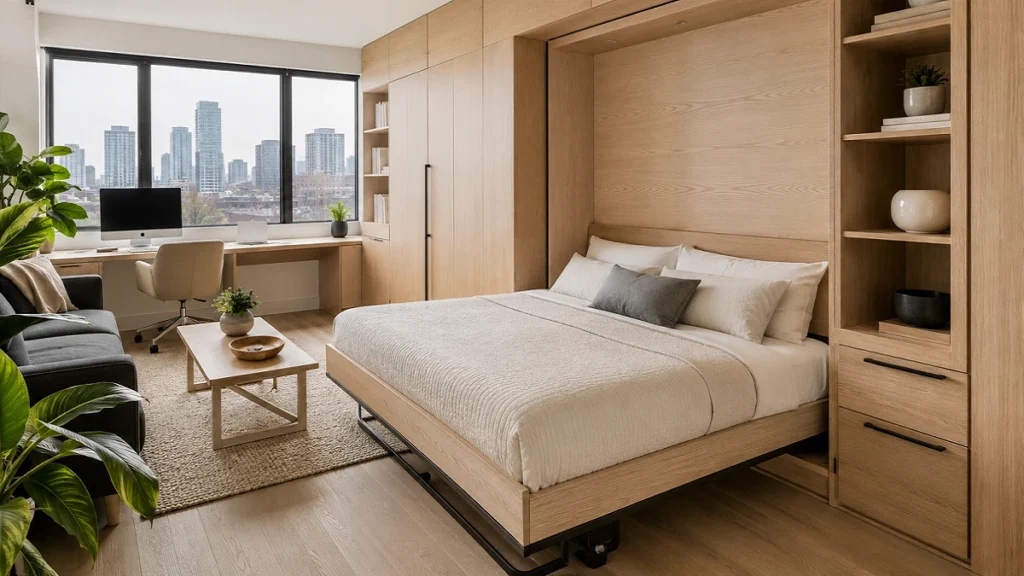
A standard queen bed occupies over $20,000 of downtown floor space. Reclaim that value instantly with a custom wall bed with storage in Montreal; the smartest investment for urban living.
Living in Montreal presents unique urban challenges—heritage buildings with compact layouts, modern condos where every square foot counts, and the constant need for multi-functional spaces.
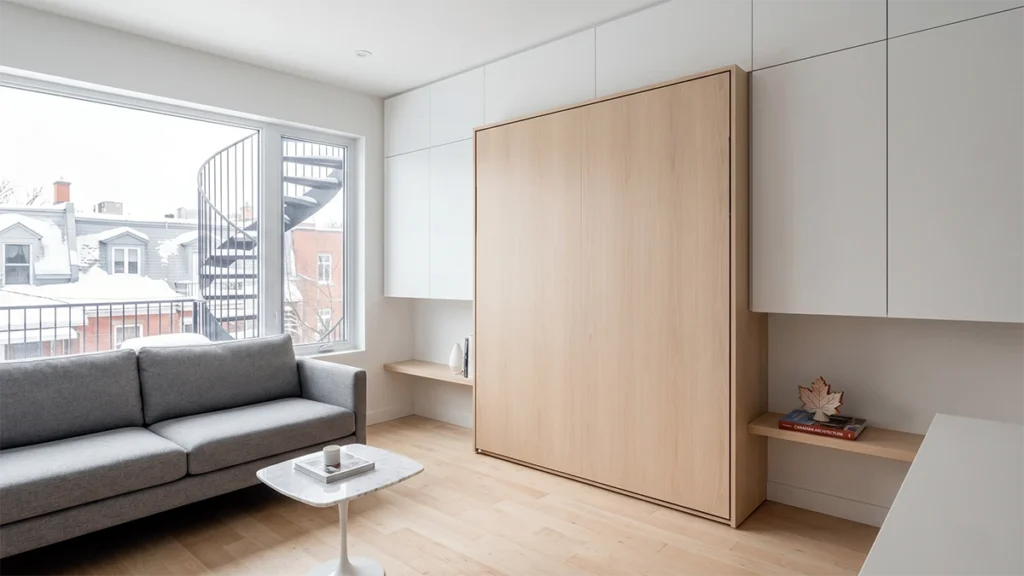
For those seeking intelligent furniture solutions, purchasing a wall bed with storage (commonly known as a Murphy bed) is a transformative decision.
This comprehensive guide is designed specifically for Montreal residents, providing in-depth insights into selecting, purchasing, and installing the perfect space-saving unit for your home.
Why a Wall Bed with Storage?
Montreal’s diverse architecture, from century-old triplexes in Le Plateau to sleek high-rises in Griffintown, often lacks ample storage and spare rooms.
A wall bed with integrated storage solves two critical urban living problems simultaneously:
Table of Contents
Factors to Consider Before Buying a Wall Bed
1. Types of Integrated Storage Configurations
When using an online configurator, you are not just buying a bed; you are designing a “Life Wall.” The storage you select must function as high-performance millwork.
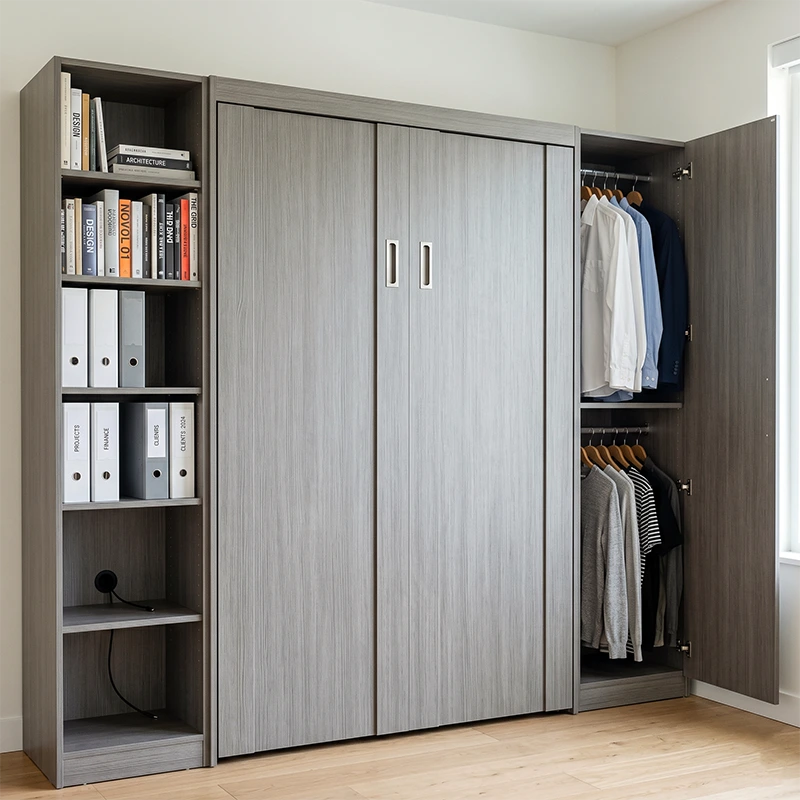
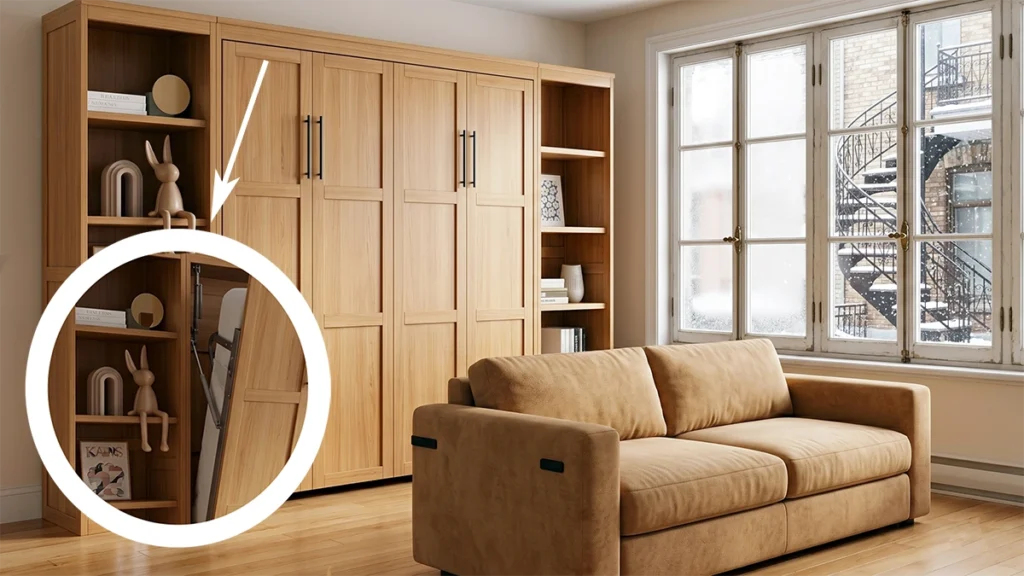
- Vertical Cabinetry & Shelving (The “Zoom Ready” Office): In Montreal’s “double parlors” often used as home offices, open shelving offers a sophisticated backdrop for video calls.
Technical Detail: Look for System 32 drill patterns (holes spaced 32mm apart). This industrial standard allows you to adjust shelf heights with precision to fit specific binders, art books, or vinyl records.
Wire Management: Premium units include grommets or “chases” behind the shelving to route cables for printers and routers, keeping the look clean.
- Full Wardrobe Closets (The Closet Substitute): For studios in Griffintown or Ville-Marie lacking built-ins, these 24-inch deep towers replace a dresser entirely.
Configuration: Choose between a “single hang” (for long coats/dresses) or “double hang” (two rods stacked) to double your storage for shirts and pants.
Internal Add-ons: Consider pull-out pantries for shoes or velvet-lined jewelry drawers to maximize utility without adding floor clutter.
- The “Floating” Cantilever Desk: This is the ultimate efficiency hack. A self-leveling desk mechanism allows the bed to lower over your workspace.
The Benefit: You do not need to clear your laptop, monitors, or coffee cup. The desk stays parallel to the floor during the transformation, saving you 10 minutes of setup time every morning and night.
Integrating this kind of self-leveling workspace is often the most practical solution for remote workers dealing with limited square footage. For a deeper dive into optimizing these dual-purpose rooms, you can explore how to set up an Easy Small Home Office with DIY Wall Bed to ensure your space remains highly functional during both day and night.
2. Mechanism Quality: The Physics of Safety
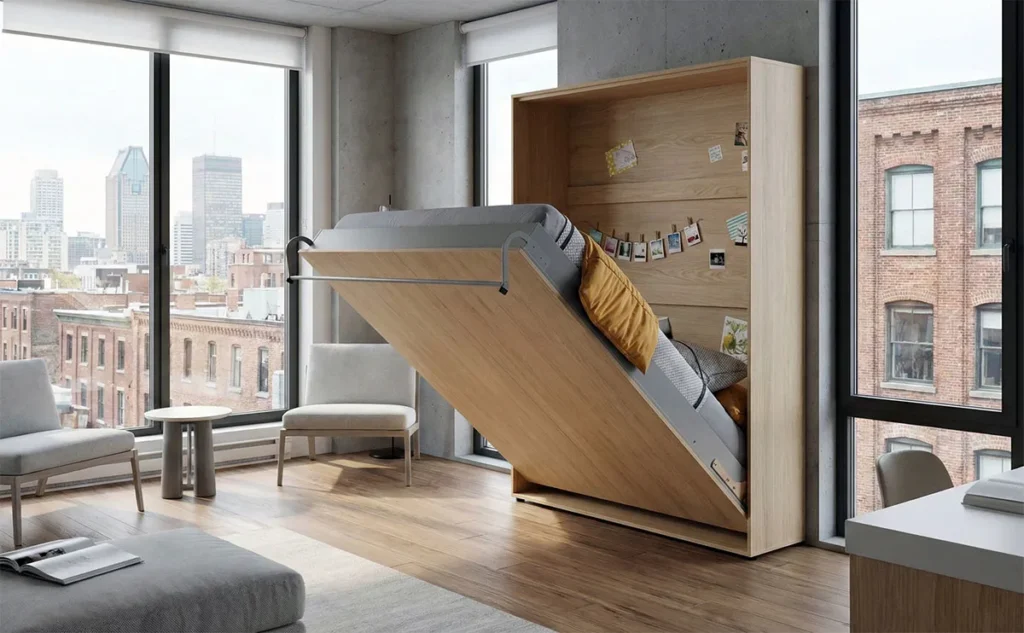
The lifting mechanism is the engine of your wall bed. Cheap spring mechanisms are the primary cause of “Murphy bed regret” due to squeaking and heaviness.
- Hydro-Pneumatic Pistons (Gas Struts): Unlike old-school metal springs that stretch and fatigue, gas pistons offer a consistent, smooth force.
Finger-Tip Operation: A correctly calibrated piston system counterbalances the mattress weight so perfectly that you should be able to lift the bed with one hand.
Cycle Rating: Look for mechanisms rated for 10,000+ cycles (roughly 25 years of daily use). This ensures the gas seal won’t fail, keeping the bed safe to operate indefinitely.
- Structural Steel Frame: Avoid beds where the mattress sits directly on wood. A powder-coated steel frame prevents warping over time—a common issue in Montreal’s humid summers. The steel frame also ensures the bed face remains rigid and square, preventing gaps in the cabinetry.
3. Mattress Specifications: The Hidden Variable
A wall bed is only as comfortable as the mattress inside, but physics dictates strict limits.
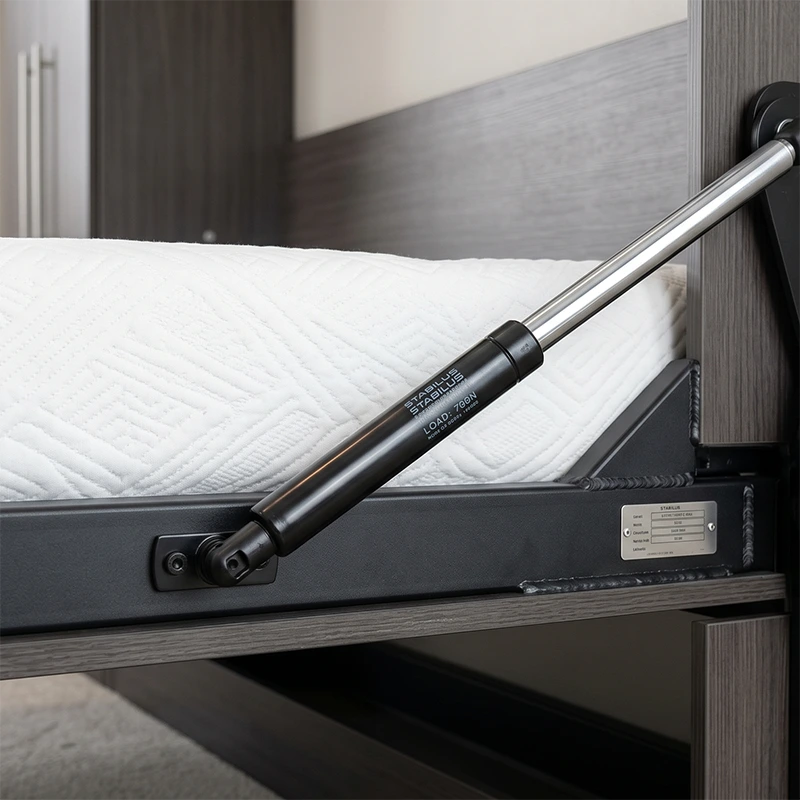
- The 11-Inch Rule: Most standard mechanisms are engineered for mattresses between 8″ and 11″ thick.
The Risk: If you force a 14″ pillow-top mattress into an 11″ cavity, the bed will not close flush, placing dangerous stress on the hinges and anchors.
- Weight Balance: The pistons are tuned to a specific weight range (e.g., 50lbs – 75lbs for a Queen).
Material Matters: High-density foam or latex mattresses are ideal. They are heavy enough to keep the bed open but light enough to lift easily. Traditional coil mattresses can “slump” when stored vertically for long periods, causing the coils to deform. Foam maintains its integrity.
Finding a mattress that balances perfectly with your piston mechanism while maintaining its structural integrity vertically can be challenging. If you are currently evaluating your options, reviewing the Best Murphy Bed Mattress can help you identify models specifically engineered for these types of vertical storage without compromising on your sleep quality.
4. Design & Material Science: Combating Montreal’s Climate
Because Montreal homes experience extreme humidity swings (dry winter heating vs. humid summer air), material choice is a structural decision, not just aesthetic.
- Thermally Fused Laminate (TFL) vs. Solid Wood: While solid wood is romantic, it expands and contracts, which can cause large cabinet doors to warp or bind.
The Solution: High-End TFL (Thermally Fused Laminate) is the industry gold standard. It is structurally stable, scratch-resistant, and impervious to humidity.
Modern “EIR” (Embossed in Register) textures mimic the grain of wood so perfectly that it is visually indistinguishable from real Oak or Walnut but offers far superior durability.
- The Euro-Slat Base: Instead of a solid plywood deck (which traps moisture and leads to mold), choose a bed with curved beechwood slats. These allow air to circulate under the mattress—critical for hygiene—and provide a “sprung” feel that improves sleep comfort.
5. Installation & Structural Integrity: The DIY Revolution
- Refined for your DIY Business Model: Historically, installation required a carpenter. Today, CNC (Computer Numerical Control) manufacturing has democratized the process, making professional-grade installation achievable for a handy homeowner.
- The “French Cleat” or Steel Rail System: Modern kits use a rail system that you mount to the wall first. Once the rail is level and hits the studs, the cabinet simply “hooks” onto it. This separates the difficult part (finding studs) from the heavy part (lifting the cabinet).
- Anchoring is Mandatory: Whether you live in a Plateau triplex with lath-and-plaster or a Griffintown condo with steel studs, the unit must be tied to the structure.
The Tip: Do not use drywall anchors. The leverage force of a lowering bed is immense. Your kit should include specific hardware for wood or steel studs.
- Baseboard Cut-Outs: A major headache in DIY is the baseboard. High-end custom configurators allow you to input your baseboard height/depth, so the side panels arrive pre-notched. This allows the unit to sit flush against the wall without you needing to own a jigsaw.

Where to Buy a Wall Bed in Montreal?
Choosing where to buy is as critical as choosing what to buy. The Montreal market is segmented into three distinct tiers. Understanding the engineering and logistical differences between these tiers will save you time and protect your investment.
A. The “Big-Box” Retailer (Imported Flat-Pack)
- Sources: Wayfair, Amazon, Generic Furniture Chains.
- The Reality: These units are typically mass-produced in overseas factories using low-density particle board (16mm thickness).
- The Risk: They rely on generic “one-size-fits-all” spring mechanisms.
- The “Montreal” Problem: These units come in fixed dimensions. If your Griffintown condo has a bulk-head that is 84 inches high, and the standard unit is 85 inches, it simply won’t fit.
- Verdict: Acceptable for temporary rentals, but a poor long-term investment for homeowners.
B. The Traditional “Atelier” (Full-Service Carpenter)
- Sources: Custom cabinet makers in areas like Rosemont or Laval.
- The Reality: Exceptional quality, solid wood or high-end veneers, and white-glove installation.
- The Risk: Cost and Lead Time. You are paying for the carpenter’s time to measure, cut manually, and install on-site. Lead times can exceed 12 weeks.
- Verdict: The luxury option for those with unlimited budgets ($8,000+).
C. The “Hybrid” Manufacturer (The Smartest Choice)
- Sources: Local manufacturers utilizing Online 3D Configurators.
- The Reality: This model bridges the gap. The furniture is produced in Montreal using the same high-precision CNC (Computer Numerical Control) machinery as the luxury carpenters. However, by allowing you to design online and assemble it yourself (DIY), you strip out the massive labor costs.
- The Advantage: You get architectural-grade materials (¾” high-density TFL) and commercial mechanisms at a mid-range price point.
- Verdict: The highest ROI (Return on Investment) for savvy Montreal homeowners.
Montreal-Specific Logistics: The “Hidden” Constraints
Living in this city presents unique logistical hurdles that generic buying guides ignore. You must audit your home against these three factors:
1. The “Escalier en Colimaçon” Factor (Spiral Staircases)
Montreal’s iconic wrought-iron staircases and narrow indoor walk-ups are the enemy of pre-assembled furniture.
- The Constraint: A pre-built queen cabinet box (approx. 65″ x 90″) literally cannot fit around the radius of a Plateau spiral staircase.
- The Solution: You must choose a Modular “Knock-Down” System. Ensure the supplier delivers the unit in “manageable packs” (none exceeding 60-70 inches in length or 50 lbs in weight). If you buy a floor model from a showroom, it likely won’t make it into your apartment.
2. Hygroscopy and The “Quebec Climate Swing”
Montreal oscillates between semi-arid winters (due to electric heating) and sub-tropical summers (90%+ humidity).
- The Science: Wood takes on and releases moisture (hygroscopy). A solid wood cabinet door can expand by up to 1/8th of an inch in July.
- The Failure Point: If the tolerances of the wall bed are too tight, this expansion can cause the bed to bind or scrape the sides.
- The Fix: Opt for Thermally Fused Laminate (TFL). It is dimensionally stable and does not react to humidity changes, ensuring the gap reveal remains perfect year-round.
3. Condo Syndicate Regulations (Co-ownership)
If you are in a condo, read your Declaration of Co-ownership regarding “Common Portions for Restricted Use.”
- Wall Anchoring: Drilling into metal studs is usually permitted as it is considered “fixing furniture,” not “structural alteration.” However, drilling into concrete party walls (the wall shared with a neighbor) may be restricted due to sound transmission risks.
- The Workaround: If you cannot drill deep into a concrete party wall, you may need to use a “Floor-to-Ceiling” tension mount or build a false back wall. Always check with your syndicate before drilling.
Comprehensive Budget Analysis
This breakdown provides a realistic view of the Total Installed Cost (TIC).
| Cost Component | Big Box Import | Hybrid / Configurator (Your Target) | Traditional Custom |
| Base Unit (Queen) | $1,200 – $1,800 | $2,200 – $3,500 | $5,000 – $9,000 |
| Storage Towers | $400 (Fixed size) | $800 – $1,500 (Custom) | $2,500+ (Custom) |
| Mechanism | Standard Spring | Piston (10k Cycles) | Piston (10k Cycles) |
| Mattress | $300 (Low density) | $600 – $1,200 (Hybrid) | $1,500+ |
| Delivery | $100 (Curbside) | $150 (Local Truck) | Included |
| Installation | DIY (Difficult) | DIY (Guided/Video) | $800 – $1,500 |
| TOTAL ESTIMATE | ~$2,000 – $2,500 | ~$3,750 – $6,000 | ~$9,800+ |
Financial Note: While the Hybrid option is higher than Big Box, the Cost Per Use is lower. A Big Box bed often fails after 3-5 years (sagging frame, squeaking springs). A Hybrid unit with a steel frame and piston mechanism is an asset that lasts 20+ years, adding permanent resale value to your condo.
Final Pre-Purchase Technical Checklist
Before clicking “Order,” verify these specific data points:
- The “Baseboard Heater” Audit:
- Do you have electric baseboards?
- Action: Measure the height and depth of the heater. Ensure your configurator design includes a “Baseboard Notch” cut-out so the unit sits flush against the drywall, not the heater.
- The Electrical Overlay:
- Are there outlets where the bed will go?
- Action: You cannot cover a live outlet. You must either decommission it or purchase a unit with integrated grommets to pull the power strip through to the desk/shelf area.
- The Ceiling Clearance Calculation:
- Is your ceiling height at least 2 inches higher than the cabinet?
- Why: You need clearance to tip the top panel into place during assembly. If your ceiling is 90″ and the cabinet is 89.5″, you cannot assemble it.
- Stud Finder Verification:
- Use a magnetic stud finder to confirm if you have Wood Studs (2×4) or Steel Studs (C-Channel).
- Why: This dictates the type of toggle bolts or lag screws you need.
FAQ Before Buying a Wall Bed with Storage
“Does a Murphy bed damage the mattress over time?”
No, provided you use the right type. Modern foam and hybrid mattresses hold their shape well when stored vertically. However, traditional coil mattresses without a border wire can “slump,” causing the coils to bunch up at the bottom. We recommend a high-density foam or pocket-coil mattress with a firm edge support. Tip: Rotate your mattress head-to-toe every 3 months.
“Can I install a wall bed on metal studs (condo walls)?”
Yes. Most modern Montreal condos (Griffintown, Laval) use metal studs. You cannot use standard wood screws. You must use specific “Toggle Bolts” (SnapToggles) that flip open inside the metal wall cavity to create a secure anchor. These can hold hundreds of pounds of shear force.
“How much weight can a wall bed hold?”
A commercial-grade wall bed frame is rated for roughly 1,000 to 2,000 lbs of static weight. The limiting factor is not the bed mechanism, but the wall anchors. As long as the unit is correctly anchored to the studs, it can easily support two adults and a pet.
“Do I need a building permit to install a Murphy bed in Montreal?”
Generally, no. A wall bed is considered “furniture” (movable property), not a structural renovation, so a city permit is not required. However, if you are moving electrical outlets or building a permanent partition wall to house the bed, you may need a minor renovation permit depending on your borough’s rules.
“Can I leave the bedding on when I close the bed?”
Yes. This is the primary advantage of a Murphy bed over a sofa bed. The cabinet depth (usually 16-18 inches) is designed to accommodate the mattress plus sheets, a duvet, and pillows. Pro-Tip: Use a “duvet strap” (usually included) to keep the bedding in place so it doesn’t slide down when the bed is vertical.